Vageesh Express


Readers Articles

Significance
of the Month of August in Hindu Calendar
The
month of Bhadrapada (August - September) commences with two glorious
celebrations:
Raksha Bandan - Aug 28th
and Thiruvonam - Aug 27th
The Significance
of Raksha Bandan!

Rakhi
- The thread of love! (Raksha means Protection. Bandhan means bond) The chaste bond of love between a brother and a sister is
one of the deepest and noblest of human emotions. 'Raksha Bandan' or 'Rakhi' is
a special occasion to celebrate this emotional bonding by tying a holy thread
around the wrist. This thread, which pulsates with sisterly love and sublime
sentiments, is rightly called the ‘Rakhi’. It means 'a bond of protection'.
Raksha Bandhan is known by various names: Vish Tarak - the destroyer of
venom, Punya Pradayak - the bestower of boons, and Pap Nashak -
the destroyer of sins.
Sisters tie colourful
'Rakhi' on the wrists of their brothers and ask their brothers to protect them
from harm. It represents one of the most sentimental festivals of
According to the custom for all
festivals and pujas, the lady of the house dresses up early in the morning in
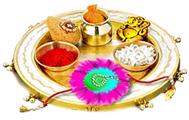
fine clothes and bathes the gods and the goddesses. The Puja thaal - with water, roli, rice, flowers, coconut, and Rakhi
is placed before the gods. After worshipping the gods the sister applies the
tilak on the forehead of her brother, and then little rice is stuck onto the
tilak. The Rakhi then is tied on
the wrists of the brother and the brother acknowledges this relationship by
accepting it with grace and love. Sisters also put some "mithai" in his mouth and bless him. With this Rakhi,
she grants deep affection and blessings on her brother so as to guard him against
all harm, and prays to the Almighty to bless her brother. These feelings are
the ones that symbolise Raksha Bandhan.
In
According
to one mythological allusion, Rakhi was intended to be the worship of the
sea-god Varuna. Hence, offerings of coconut to Varuna, ceremonial bathing and
fairs at waterfronts accompany this festival. There are also myths that
describe the ritual as observed by Indrani and Yamuna for their respective
brothers Indra and Yama.Once, Lord Indra stood almost vanquished in a
long-drawn battle against the demons. Full of remorse, he sought the advice of
Guru Brihaspati, who suggested for his sortie the auspicious day of Shravan
Purnima (fullmoon day of the month of Shravan). On that day, Indra's wife and
Brihaspati tied a sacred thread on the wrist of Indra, who then attacked the
demon with renewed force and routed him. Thus the Raksha Bhandhan symbolizes
all aspects of protection of the good from evil forces.
Rituals
like Rakhi, there is no doubt, help ease out various societal strains, induce
fellow-feeling, open up channels of expression, and give us an opportunity to
rework on our role as human beings and, most importantly, bring joy in our
mundane lives.
Significance of Thiruvonam/Onam!
Onam
is one of the most important festivals of Kerala. It is a bright and colorful
festival that celebrates the bounties of nature and a year of good harvest. The
festival stretches on for ten days - days filled with feasting, boat racing,
singing and dancing. Onam is a celebration of 10 days. It comes in the month of
"Chingam" according to Malayalam calendar.
Onam
or Thiruonam originated as a joyous annual reminiscence of the golden rule of
King Mahabali, a mythical king, who ruled Kerala a very long time ago. It
recalls the sacrifice of the great king, his true devotion to God, his human
pride and his ultimate redemption. Onam welcomes the spirit of a great king,
and assures him that his people are happy and wish him well.
 The people in Kerala celebrate the Onam festival by
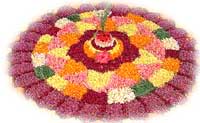
cleaning their houses and decorating them. They put flower mats called ‘pookolam’ in front of their homes, to
welcome the King. Earthen mounds representing Mahabali and Vishnu are placed in
the dung-plastered courtyards. On Onam, everybody in the family wear new
clothes. Keralites all over the world celebrate these ten days will pomp and
gaiety. They visit almost all temples which they can, they perform dances like
Thiruvathira kali Thumbi Tullal etc. to name a few. The dances are followed by
a grand lunch called 'Sadhya'. There is a saying in Malayalam that "kanam vittu onam unnanam" which
means "We should have the Thiruonam lunch even if we have to sell all our
property". Delicious sweetmeats and favorite vegetarian dishes are cooked
and served on banana leaves. One favorite dessert that is served on the day is
‘payasam’, a sweet porridge. Spectacular parades of caparisoned elephants, fireworks
and the famous Kathakali dance are traditionally associated with Onam. It is
also the season of many cultural and sport events and carnivals.
The people in Kerala celebrate the Onam festival by
cleaning their houses and decorating them. They put flower mats called ‘pookolam’ in front of their homes, to
welcome the King. Earthen mounds representing Mahabali and Vishnu are placed in
the dung-plastered courtyards. On Onam, everybody in the family wear new
clothes. Keralites all over the world celebrate these ten days will pomp and
gaiety. They visit almost all temples which they can, they perform dances like
Thiruvathira kali Thumbi Tullal etc. to name a few. The dances are followed by
a grand lunch called 'Sadhya'. There is a saying in Malayalam that "kanam vittu onam unnanam" which
means "We should have the Thiruonam lunch even if we have to sell all our
property". Delicious sweetmeats and favorite vegetarian dishes are cooked
and served on banana leaves. One favorite dessert that is served on the day is
‘payasam’, a sweet porridge. Spectacular parades of caparisoned elephants, fireworks
and the famous Kathakali dance are traditionally associated with Onam. It is
also the season of many cultural and sport events and carnivals.
One
of the main attractions of Onam, is the 'Vallamkali' or boat races of
Karuvatta, Payippad, Aranmula and Kottayam. Hundreds of oarsmen row traditional
boats to the rhythm of drums and cymbals. These long graceful Snake Boats
called 'Chundans' are named after their exceedingly long hulls and high sterns
that resemble the raised hood of a cobra. Then there are 'Odis', the small and
swift raiding crafts adorned with gold tasseled silk umbrellas, the 'Churulans'
with their elaborately curled prows and sterns, and the 'Veppus', a kind of
cook-boat. This traditional village rivalry on watercrafts reminds one of
ancient naval warfare. Thousands throng
the banks to cheer and watch the breathtaking show of muscle power, rowing
skills and rapid rhythm. These boats - all pitted against their own kind - rip
through the backwaters of Kerala in a tussle of speed.
Although
this festival has its origin in Hindu mythology, Onam is for all people of all
class and creed. Hindus, Muslims and

Source: http://hinduism.about.com
Submit feedback to newsletter@mahaganapati.org with subject line as <Reader Articles> Disclaimer: Views of readers/column
writers are that of their own and not of the
