Vageesh Express

August 2006 Edition
Deity of the Month

Deity of the Month
Saraswathi
She will be on the white lotus,
in the music of the Veena,
Will be in the heart of the poets
who sing great pleasurable songs.
As the inner meaning of the chanted verses,
she will shine from within the Vedas.
This is how Goddess Saraswathi is praised by Amarakavi (eternal poet) Subramania Bharathi. She is worshipped by children and people seeking knowledge. Although she is the embodiment of knowledge itself, she still is learning – indicating that there is no end to knowledge.
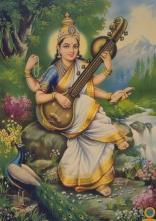
Saraswathi is depicted clad in white, with a beautiful and very fair skin and with a smile in her face. The white clothes indicate purity -- knowledge leading to wisdom and enlightenment. Her beauty indicates the inner beauty associated with true knowledge. The veena in her hand shows that she is the giver of art, music, the peace associated with true knowledge. Hence she is called Kalaimagal, or goddess of art. She holds a string of beads and palm-leaves in her hand – representing the wisdom and spiritual knowledge leading to Moksha and the Vedas that impart it.
She is called Brahmi, which makes her the wife, or the energy of the creator, Brahma. She is said to reside in Brahma’s tongue – the Vedas that come from his tongue – speech that is associated with knowledge, creation. Hence she is known as Vidya. Saraswathi is also believed to be the daughter of Siva and Parvathi by some traditions. Hence she is also called Sivanuja.
The meaning of Saraswathi is ‘one who has lakes or ponds’, an apt name for one who is the ocean of knowledge. Archeology indicates that Vedic culture grew on the banks of river Saraswathi, river of knowledge. What could be more befitting for this goddess of knowledge! She is also considered by many as the one who gives the essence (sara) of our own self (swa).
The sacred period for worshipping Saraswathi is Saraswathi Puja, ninth day of Navarathri. People worship her in the form of books by placing them in front of her on that day.
Legend says that Saraswathi debated with Adi Sankarar as the wife of a famous guru and queried about the only knowledge he did not possess at that time, knowledge of woman. To acquire that knowledge, Adi Sankarar occupied the body of a dead king, acquired that knowledge and defeated Saraswathi. She then followed Adi Sankara to Sringeri. She is worshipped as Saradha by the Sringeri Sankara Mutt. In respect of her, all the Sankaracharyas of Kanchi Kamakoti Peetam are revered with the last name, Saraswathi.
There are two famous temples for Saraswathi in India. One, Sri Saraswathi Temple is situated at Koothanur, It is about fifteen kilometers away from Mayiladuthurai, of Nagapattinam District in Tamilnadu, India. Another is located in Andhra Pradesh, in village of Basar. A third one, Maha Saraswathi Temple at Krall near Ramban in Jammu and Kashmir is a modern temple in the Dravidian style commemorating the time immemorial shrine to Saraswathi in the Kashmir area. It is now in ruins.
Saraswathi is worshipped as Tara in Buddhism. Although largely forgotten in China now, she is still worshipped in Japan under the name Benzaiten.
Let us pray to Goddess Saraswathi to impart us with spiritual knowledge for attaining Moksha.
Submit feedback to newsletter@mahaganapati.org with subject line as <Deity of the Month> Disclaimer: Views of readers/column writers are that
of their own and not necessarily of the Temple
