Vageesh Express



Significance of the Month of August in Hindu Calendar
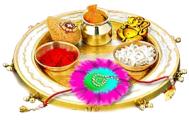
Raksha Bandan - Aug
9th, Krishna Janmashtami - Aug 16th and Vinayak/Ganesh
Chaturthi - Aug 27th
The Significance of Raksha Bandan!

Rakhi
- The thread of love! (Raksha means Protection. Bandhan means bond) The chaste bond of love between a brother and a sister is
one of the deepest and noblest of human emotions. 'Raksha Bandan' or 'Rakhi' is
a special occasion to celebrate this emotional bonding by tying a holy thread
around the wrist. This thread, which pulsates with sisterly love and sublime
sentiments, is rightly called the ‘Rakhi’. It means 'a bond of protection'.
Raksha Bandhan is known by various names: Vish Tarak - the destroyer of
venom, Punya Pradayak - the bestower of boons, and Pap Nashak -
the destroyer of sins.
Sisters tie colourful
'Rakhi' on the wrists of their brothers and ask their brothers to protect them
from harm. It represents one of the most sentimental festivals of India. It is
based on the emotional ties that bind a brother and sister in a very close bond
- the most sacred relationship of life, without any ulterior motive or demand
of any kind. It is a day of festivity and pure joy. The ritual is observed on the full moon day of the Hindu
month of Shravan, on which sisters tie the sacred Rakhi string on their
brothers' right wrists, and pray, for their long life. Rakhis are ideally made
of silk with gold and silver threads, beautifully crafted embroidered sequins,
and studded with semi precious stones. This ritual not
only strengthens the bond of love between brothers and sisters, but also
transcends the confines of the family. When a Rakhi is tied on the wrists of
close friends and neighbors, it underscores the need for a harmonious social
life, where every individual co-exist peacefully as brothers and sisters. It
won’t be wrong to say the fashionable friendship band in vogue today is an
extension of the Rakhi custom.
According to the custom for all
festivals and pujas, the lady of the house dresses up early in the morning in
fine clothes and bathes the gods and the goddesses. The Puja thaal - with water, roli, rice, flowers, coconut, and Rakhi
is placed before the gods. After worshipping the gods the sister applies the
tilak on the forehead of her brother, and then little rice is stuck onto the
tilak. The Rakhi then is tied on
the wrists of the brother and the brother acknowledges this relationship by
accepting it with grace and love. Sisters also put some "mithai" in his mouth and bless him. With this Rakhi,
she grants deep affection and blessings on her brother so as to guard him
against all harm, and prays to the Almighty to bless her brother. These
feelings are the ones that symbolise Raksha Bandhan.
In
Northern India, Rakhi Purnima is also called Kajri Purnima or Kajri Navami,
when wheat or barley is sown, and goddess Bhagwati is worshipped. In Western
states, the festival is called Nariyal
Purnima or the Coconut Full Moon.
In Southern India, Shravan Purnima is an important religious occasion and is
called Avani Avittam. This falls on
the full moon day of the month of Shravan (August-September). The men observing
the festival wear a new holy thread and offer libations of water to the ancient
Rishis on this day. This festival is also known as Upakarmam.
According
to one mythological allusion, Rakhi was intended to be the worship of the
sea-god Varuna. Hence, offerings of coconut to Varuna, ceremonial bathing and
fairs at waterfronts accompany this festival. There are also myths that
describe the ritual as observed by Indrani and Yamuna for their respective
brothers Indra and Yama.Once, Lord Indra stood almost vanquished in a
long-drawn battle against the demons. Full of remorse, he sought the advice of
Guru Brihaspati, who suggested for his sortie the auspicious day of Shravan
Purnima (fullmoon day of the month of Shravan). On that day, Indra's wife and
Brihaspati tied a sacred thread on the wrist of Indra, who then attacked the
demon with renewed force and routed him. Thus the Raksha Bhandhan symbolizes
all aspects of protection of the good from evil forces.
Rituals
like Rakhi, there is no doubt, help ease out various societal strains, induce
fellow-feeling, open up channels of expression, and give us an opportunity to
rework on our role as human beings and, most importantly, bring joy in our
mundane lives.
Janmashtami
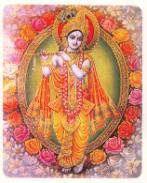
“ I am the conscience in the heart of all creatures
I am their beginning, their being,
their end
I am the mind of the senses,
I am the radiant sun among lights
I am the song in sacred lore,
I am the king of deities
I am the priest of great seers…"
This
is how Lord Krishna describes God in the Holy Bhagavad Gita. And to most
Hindus he is the God himself, the Supreme Being, the Absolute, the Brahman, and
the Purna Purushotam. The great exponent of the Gita, Krishna is
the complete incarnate of Vishnu, the Godhead of the Hindu Trinity of deities.
Of all the Vishnu avatars he is the most popular, and perhaps of all Hindu gods
the one closest to the heart of the masses. Krishna has influenced the Indian
thought, life and culture in myriad ways. He has influenced not only its
religion and philosophy, but also into its mysticism and literature, painting
and sculpture, dance and music, and all aspects of Indian folklore. The
birthday of such a favorite deity is bound to be a special occasion for the
Hindus, who consider Krishna their leader, hero, protector, philosopher,
teacher and friend all rolled into one.
Time of the Lord - Krishna took birth at midnight on the ashtami or
the 8th day of the Krishnapaksha or dark fortnight in the Hidu month of
Shravan (August-September). This auspicious day is called Janmashthami. It is
believed that Mother Earth, unable to bear the burden of sins committed by evil
kings and rulers, appealed to Brahma, the Creator for help. Brahma prayed to
the Supreme Lord Vishnu, who assured him that he would soon be born on earth to
annihilate tyrannical forces. One such evil force was Kamsa, the ruler of
Mathura (in northern India). His sunjects were utterly terrified of him. On the
day Kamsa's sister Devaki was married off to Vasudeva, an akashvani or
voice from the sky was heard prophesying that Devaki's 8th son would be the
destroyer of Kamsa. The frightened Kamsa immediately unsheathed his sword to
kill his sister but Vasudeva intervened and implored Kamsa to spare his bride,
and promised to hand over every new born child to him. Kamsa relented but
imprisoned both Devaki and her husband Vasudeva.
 When Devaki gave birth to her first child, Kamsa came to
the prison cell and slaughtered the newborn. In this way, he killed the first
six sons of Devaki. Even before her 8th child was born, Devaki and Vasudeva
started lamenting its fate and theirs. Then suddenly Lord Vishnu appeared
before them and said he himself was coming to rescue them and the people of
Mathura. He asked Vasudeva to carry him to the house of his friend, the cowherd
chief Nanda in Gokula right after his birth, where Nanda's wife Yashoda had
given birth to a daughter. He was to exchange his boy and bring Yashoda's baby
daughter back to the prison. Vishnu assured them that "nothing shall bar
your path".
When Devaki gave birth to her first child, Kamsa came to
the prison cell and slaughtered the newborn. In this way, he killed the first
six sons of Devaki. Even before her 8th child was born, Devaki and Vasudeva
started lamenting its fate and theirs. Then suddenly Lord Vishnu appeared
before them and said he himself was coming to rescue them and the people of
Mathura. He asked Vasudeva to carry him to the house of his friend, the cowherd
chief Nanda in Gokula right after his birth, where Nanda's wife Yashoda had
given birth to a daughter. He was to exchange his boy and bring Yashoda's baby
daughter back to the prison. Vishnu assured them that "nothing shall bar
your path".
At
midnight on ashtami, the divine baby was born in Kamsa's prison.
Remembering the divine instructions, Vasudeva clasped the child to his bosom
and started for Gokula, but found that his legs were in chains. He jerked his
legs and was unfettered! The massive iron-barred doors unlocked and opened up.
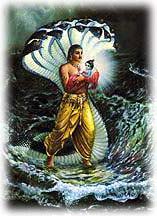
While crossing river Yamuna, Vasudeva held his baby high over his head. The
rain fell in torrents and the river was in spate. But the water made way for
Vasudeva and miraculously a five-mouthed snake followed him from behind and
provided shelter over the baby.
When
Vasudeva reached Gokula, he found the door of Nanda's house open. He exchanged
the babies and hurried back to the prison of Kamsa with the baby girl. Early in
the morning, all the people at Gokula rejoiced the birth of Nanda's beautiful
male child. Vasudeva came back to Mathura and as he entered, the doors of the
prison closed themselves. When Kamsa came to know about the birth, he rushed
inside the prison and tried to kill the baby, but this time it skipped from his
hand and reaching the sky. She was transformed into the goddess Yogamaya, who
told Kansa: "O foolish! What will you get by killing me? Your nemesis is
already born somewhere else." In his youth Krishna killed Kamsa along with
all his cruel associates, liberated his parents from prison, and reinstated
Ugrasen as the King of Mathura.
Whether
he was a human being or God-incarnate, there is no gainsaying the fact that he
has been ruling the hearts of millions for over three millennia. In the words
of Swami Harshananda, "If a person
can affect such a profound impact on the Hindu race affecting its psyche and
ethos and all aspects of its life for centuries, he is no less than God."
Source: http://hinduism.about.com
Submit feedback to newsletter@mahaganapati.org with subject line as <Reader Articles: August Significance> Disclaimer: Views of readers/column writers are that
of their own and not of the Temple
