Vageesh Express

August 2006 Edition
Vedic Bytes

Mantras
& Brahmanas
Mantras Continued….
Last month we discussed the representative mantra of all the Hindu mantras famed as Gayatri Mantra.
We continue on with few significance of ‘OM’ and Prayers, Mantras, and Kirtans.
The Significance of the Symbol Om
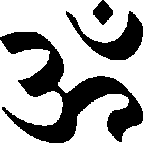
Aum (also Om or Ohm)
is the most sacred
syllable in Hinduism,
symbolizing the infinite Brahman and the entire Universe. The syllable
is sometimes referred to as the "Udgitha" or "pranava
mantra" (primordial mantra); not only because it is considered to be the
primal sound, but also because most mantras begin with
it. As a seed syllable (bija), it is also considered holy in Esoteric Buddhism.
Volumes have been written in Sanskrit illustrating the significance of
this mystic symbol. Although this symbol is mentioned in all the Upanishads and
in all Hindu scriptures, it is especially elaborated upon in the Taittiriya,
Chandogya and Mundaka Upanishads.
The goal, which all Vedas declare, which all austerities aim at, and which humans desire when they live a life continence, is Aum. The syllable Aum is indeed Brahman. This syllable Aum is the highest. Whosoever knows this symbol obtains all that he desires. This is the highest support. Whosoever knows this support is adored in the world of Brahman.
— Katha Upanishad I, ii, 15-17
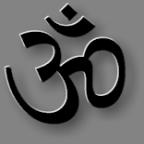
The symbol Aum contains three curves, one semicircle and a dot. The large lower curve symbolizes the waking state; the upper curve denotes deep sleep (or the unconscious) state, and the lower curve (which lies between deep sleep and the waking state) signifies the dream state. These three states of an individual’s consciousness, and therefore the entire physical phenomenon, are represented by the three curves. The dot signifies the Absolute (fourth or Turiya state of consciousness), which illuminates the other three states. The semicircle symbolizes maya and separates the dot from the other three curves. The semicircle is open on the top, which means that the absolute is infinite and is not affected by maya. Maya only affects the manifested phenomenon. In this way the form of Aum symbolizes the infinite Brahman and the entire Universe.
Found first in the Vedic scriptures of Hinduism, Aum has been seen as the first manifestation of the unmanifest Brahman (the single Divine Ground of Hinduism) that resulted in the phenomenal universe. Essentially, all the cosmos stems from the vibration of the sound 'Aum' in Hindu cosmology. Indeed, so sacred is it that it is prefixed and suffixed to all Hindu mantras and incantations. It is undoubtedly the most representative symbol of Hinduism.
Gods and Goddesses are sometimes referred to as Aumkar, which means Form of Aum, thus implying that they are boundless and the vibrational whole of the cosmos. Ek Onkar, meaning 'one god' is a central tenet of Sikh religious philosophy. In Hindu metaphysics, it is proposed that the manifested cosmos (from Brahman) has name and form (nama-rupa), and that the closest approximation to the name and form of the universe is Aum, since all existence is fundamentally composed of vibration. (This concept of describing reality as vibrations, or rhythmic waves, can also be found in quantum physics and super string theory, which describe the universe in terms of vibrating fields or strings.)
Mantras and Prayers
A mantra is a sacred syllable, word or verse, which has been revealed to a sage in deep meditation. A mantra, when recited with devotion, concentration and understanding, revitalizes the body and mind with mystic power, and harmonizes thought and action.
A mantra, when repeated constantly during meditation, first loudly and then through silent and mental chanting, changes the consciousness.
Prayer is uplifting inspiring and fascinating for the mind and it has great power. Therefore, it is very important that each of us learns to pray. Through prayer we purify our mind and gain spiritual strength. Thus prayer is the foundation of success.
Kirtan or Bhajan
A bhajan or kirtan is a Hindu or Sikh devotional song, often of ancient origin. Great importance is attributed to the singing of bhajans.
When a mantra is sung or chanted, whether by oneself or in a group of devoted aspirants, it is termed as Kirtan — the glorification of God. Prayers or symbolic stories of God may also be sung in a Kirtan.
The singing and chanting of Kirtan creates an elevated mental condition for practicing meditation or entering into an intense form of spiritual practice. Kirtan is a powerful and unique method of recharging the subconscious with spiritual vibrations.
References:
1. http://www.orientalia.org/modules.php?name=Encyclopedia&file=search&query=Upanisads
2. Vedic Samhitas and Brahmanas by Vishal Agarwal
3. http://www.answers.com/topic/mantra?method=22
Submit feedback to newsletter@mahaganapati.org with subject line as <Vedic Bytes> Disclaimer: Views of readers/column writers are that
of their own and not of the Temple
