
Significance of the Month of December in
Hindu Calendar
The
Hindu
month of Maargasira - (December) commences
with the celebrations of Kaarthikai Deepam on December 3, 2006 and Vaikunta
Ekadasi on December 30, 2006.
Significance Kaarthikai Deepam!
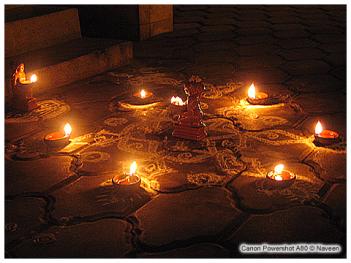
Karthikai Deepam, the festival of lights celebrated
throughout Tamil Nadu during the month of Karthikai (November-December).
Not many of us are aware that it is one of the
oldest festivals celebrated in the State, perhaps even before people began
celebrating Deepavali and Navarathri. The Karthikai Deepam day commemorates the
appearance of the Lord as a jothi sthambam, an infinite pillar of light at
Arunachala. This festival falls in the Tamil month of Kartigai when the star
Krithika is on the ascendant and usually occurs on a full moon day.
One of the earliest references to the festival is
found in the Aga Nanooru, a book of
poems, which dates back to the Sangam Age (200 B.C. to 300 A.D.). The Aga
Nanooru clearly states that Karthikai is celebrated on the full moon day
(pournami) of the Tamil month of Karthikai. It was one of the most important
festivals of the ancient Tamils. Avaiyyar, the renowned poetess of those times,
refers to the festival in her songs. In another epic Jeevaka Chintamani written
by a Jain poet, Thiruthakka Thevar, the poet describes how people celebrated
the Karthikai Deepam festival. A mid-sixteenth Century inscription at the
Arulalaperumal temple in Kancheepuram, refers to the festival as Thiru Karthikai
Thirunal. In Sambandar´s Tevaram, while trying to raise a young girl Poompavai
from the dead, he asks with deep feeling, "O Poompavai, have you gone without seeing the ancient Karthikai
festival?" Another song in Tevaram says that the Lord is verily the
deepam (lit during the Karthikai festival).
There is a work on Karthikai Deepam consisting of a
hundred stanzas, praising the festival. When Muruganar asked Bhagavan Ramana
about the significance of the Karthikai Deepam festival, Bhagavan composed a stanza
of four lines in which he says, "The true significance of the Karthikai
Deepam festival is that it turns the intellect inwards and having fixed it in
the Heart merges it with the indweller of the Heart". Karthikai is
essentially a festival of lamps. The lighted lamp is considered an auspicious
symbol. It is believed to ward off evil forces and usher in prosperity and joy.
While the lighted lamp is important for all Hindu rituals and festivals, it is
indispensable for Karthikai.
A story goes like this. There was a demon who had,
by severe austerities, obtained the boon that he could be invincible and
immortal so long as the three forts in which he had entrenched himself were not
demolished in one stroke. Because of these three forts or cities he had come to
be known as Tripurasura. The forts were impregnable, one within the other. If
only one or two of them were destroyed by his opponents, they would immediately
spring up again as strong as ever and the demon would remain unconquerable for
such was the boon. Only when all the three forts were demolished and razed to
the ground in one stroke and at the same time could the demon be vanquished and
destroyed. All the forces of the gods tried to rid the world of the atrocities
and tyranny of the demon but could not succeed. In despair the defeated gods
approached Lord Shiva to come to their help and protect the world.
The merciful Lord Shiva agreed and all the gods
joined Him and made up His equipment. Armed with the organized strength of the
gods, he took up his great bow and sallied forth against the demon. In the
beginning, He too demolished one fort or two but found them springing up again
and again without even as much as a scratch. Then remembering the boon the
demon had been blessed with, Lord Shiva took out His terrible Arrow and shot it
at the three forts and lo! The impregnable walls came crumbling down and became
dust and could not come into being again and the fearful demon deprived of his
invincible shelter was slain The whole creation heaved a sigh of relief and
once again righteousness reigned in the world People could freely follow their
religious duties and live in peace and prosperity. It was this auspicious
Kartika Purnima-Full Moon Day-when this great victory of good over evil was
achieved and so it is observed as a day of rejoicing and at night a big light
is lighted in honor of the Lord's victory.
Every individual soul is encased in three bodies-the
Karana, Sukshma and the Sthula. The food and breath sheaths make up the gross
or physical body, sthula sharira. The breath, emotion and intelligence sheaths
make up the subtle or astral body, sukshma sharira. The intelligence and bliss
sheaths make up the causal body, karana sharira. This so-called myth bears one
more interpretation and has a lesson for us-the Hindu people of today. We are
essentially devoted to the spirit though today we seem to have forgotten our
holy heritage. Whereas people in the rest of the world are following in the
pursuit of happiness in this life - happiness supposed to be born of material
" prosperity and power - our great thinkers have realized the evanescence
of mundane pleasures and sought after real happiness, pure unadulterated,
eternal and realized that Truth, the effulgent, immortal, all surpassing Bliss,
the principle which as the material, efficient and intelligent cause of all
creation, past, present and future, is imminent in it and transcends it as
well, knowing which and becoming one with which, the individual attains the
ultimate goal of existence. This Truth is in our keeping as it were, handed
down to us by our seers and the sacred duty is cast upon us to broadcast it to
the world and see that every human being realizes it and becomes one with
all-pervading spirit. We have to live so as may be able to discharge this duty
efficiently.
Significance Vaikunta Ekadasi!
THE WEATHER is quite chilly during the month of Maargahi mornings.
No wonder, for, the winter is at its peak in December. At a time when most of
us don't stir out of bed for a morning
walk, you can see women and men on their way to the temple, for it is the month
of Margazhi and having an early morning
darshan in temples will definitely fulfill prayers. Most of the women wake up
as early as 4.00 a.m. and have the doorstep decorated with beautiful `kolams'. One can also witness pumpkin
flowers sprouting out right at the centre of the `kolams'. The next immediate
job for them is a visit to temple in groups. Mostly young girls gather in
groups and recite the hymns of `Tiruppavai' while going round the temple, in
keeping with the traditional belief that they will soon get married.
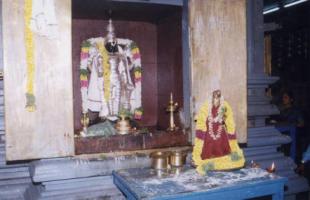
The belief originated from the legend of Aandal, one of
the best-loved poet-saints of the Tamils. Pious tradition sees her veritable
descent of `Bhumi Devi' (Mother
Earth) in `human form' to show humanity the way to His lotus feet (Lord
Ranganatha). She is present in all Vaishnavite temples, in India and elsewhere,
next to her Lord, as she always desired.
 Aandal is better
remembered for her hymns. Describing herself as a young girl, still not fully
mature, she seeks the help of all including animals in her quest to attain Him.
Finally, she describes her good fortune of being the daughter of Vishnuchitta
(also known better as `Periyalvar), the best of the devout, who lived in
Srivilliputtur, and adores the Lord. Her first work, `Tiruppavai', is a poem of 30 verses in which Aandal imagines
herself a cowherd girl and yearns to serve Him to achieve happiness not only in
this birth, but also in eternity, and describes the religious vow (pavai) that
she and her fellow cowgirls will take for this purpose.
Aandal is better
remembered for her hymns. Describing herself as a young girl, still not fully
mature, she seeks the help of all including animals in her quest to attain Him.
Finally, she describes her good fortune of being the daughter of Vishnuchitta
(also known better as `Periyalvar), the best of the devout, who lived in
Srivilliputtur, and adores the Lord. Her first work, `Tiruppavai', is a poem of 30 verses in which Aandal imagines
herself a cowherd girl and yearns to serve Him to achieve happiness not only in
this birth, but also in eternity, and describes the religious vow (pavai) that
she and her fellow cowgirls will take for this purpose.
The impact of these works on the daily religious life of
the south Indians could be witnessed in all Vaishnavite temples. Discourses on
`Tiruppavai' had become part and of `Margazhi'. It is a busy month for most of
the Vaishnavite Temples. Apart from spiritual discourses and heavy inflow of
devotees, it is the month on which the `Vaikunta Ekadasi' is celebrated.
It is considered holy, for, it is the day in which the
Lord comes out of the sanctum sanctorum and enters the `Vaikunta vaasal' also
known as `sorga vaasal'. People generally consider the `Vaikunta vaasal' as the
gateway to paradise.
Though there are two `Ekadasis' figuring in each month,
the one in `Marghazhi' is considered special. There are several interpretations
to the `Vaikunta Ekadasi. The one revealed by the `Padma Puranam' is quite
popular. It says `Ekadasi' is the female energy of Lord Vishnu which slains
demon Muran in the form of a damsel and protects `Devas'. Impressed by the act,
Lord Vishnu names her as `Ekadasi' and gives her the boon that those who
worship `Ekadasi' would reach `Vaikunta' (His abode). And it happened in the
month of Margazhi, hence, the Ekadasi of this month is quite famous. If it is
`Vaikunta Ekadasi' for Vaishnavites, it is `Nanjunda Ekadasi' for the Saivites.
Some of the Saivites believe that it was on this day Lord Shiva consumed the
`nanju', the poison that emanated from the churning of the ocean.
It is also the prime season for Ayyappa devotees. Not a
day passes without the Ayyappa devotees flooding temples. For, this is the
month in which devotees all over the world perform the famous `Mandala puja'
for Lord Ayyappa. Sandwiched between the months of `Karthigai' and `Thai',
plenty of activities are scheduled for this month. During this month the
Sabarimala Ayyappa Temple is closed for darshan after the `Mandala puja' and
reopens on the New Year Day. It will be
unfair to leave the `Bhogi festival'
untouched. Though it is related to the Pongal
commencing Thai maasam `Bhogi' falls on the last day of `Margazhi',
preparing the people to usher in the month of `Thai'
Sources:
http://www.mailerindia.com/hindu/veda/index.php?karhikai
Submit feedback to newsletter@mahaganapati.org with subject line as <Reader Articles> Disclaimer: Views of readers/column writers are that
of their own and not of the Temple
