Vageesh Express


July 2006 Edition
Temple Tour


Hindu Temples in the United
States
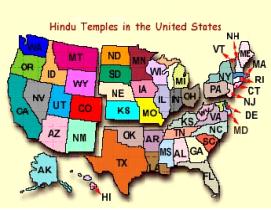
India is a land of artistic and wonderful temples. Hindu Temples have not only been great abodes for worship but landmarks of architecture of the Indian sub-continent.
Indians who have settled in the United States look for the same peaceful abodes to pray and worship the many gods and goddesses. The religious landscape of the southeastern United States is becoming more diverse, as is the population. Along with the “church on every corner,” Hindu temples, Buddhist centers, mosques, and other religious centers contribute to the communities of this region.
We have
to applaud the work of the many Indians who have come together to build these
temples and places of worship for the Indian population. Some of the
architectural marvels that have sprung from this hard work will make one feel
as if visiting a temple in India.
Many temples are open daily for worship (morning and/or evening), often with longer hours on the weekends. Some have hired one or more full-time priests, while volunteers lead the rituals in other temples. Hindu festivals and holy days are celebrated at these temples with special rituals, food, cultural events, and socializing. Most of the temples also have the infrastructure for social and cultural events.
The purpose of this segment is to focus and familiarize the significance of each these temples.

Driving directions from
Airport to the Temple:
·
Head north from Messer Airport Hwy - go 69 ft
·
Bear left - go 0.5 mi
·
Continue on Messer Airport Hwy - go 0.9 mi
·
Bear right into the I-20 W/I-59 S entry ramp to
Tuscaloosa/Downtown - go 4.7 mi
·
Take the I-65 S exit 124A to Montgomery - go 8.5 mi
·
Take the US-31 exit 252 - go 0.2 mi
·
Bear right onto the US-31 S ramp to Hoover - go 197 ft
·
Bear right at Montgomery Hwy - go 3.2 mi
·
Continue on US-31 N - go 1.4 mi
·
Turn right at Valleydale Rd - go 1.5 mi
·
Turn left at N Chandalar Dr - go 0.1 mi
Temple
Timings
|
Week Days and
Weekends 8:00 am – 12 noon 5:00 pm - 8:30 am |
About
the Temple:
As
in tradition as well as described in Vaastu Shaastras the mandir in Birmingham
is a three dimensional representation of a mandala or a representation of
cosmos in miniature. It is 3,600 square feet square structure with the
principle entrance from north leading to the chief sanctuary (garbha-grha or
mulasthana) of the mandir. The deities are arranged in a U Shape with the
principal deities in north-south axis.
The nine main vedic-murti's are in the main arrangement and there is
provision for subsidiary deities in individual niches along the wall. The hall
for the worshippers (mandap) is large and accommodates up to 300 devotees
simultaneously. There is a provision for circumbulation (pradhakshina) and the
decoration (alankar) of individual deities is done in traditional Hindu mandir
style. The temple provides an extraordinary facility for worship both
individual and group, performance of rite of passage, and celebration of
festivals for our community.
Historic Review of the Temple:
A
place for worship and cultural activities has long been a dream for the Indian
community of Birmingham. Well, by grace of Almighty, tireless efforts and
financial support of a number of dedicated individuals, the dream of having the
temple and cultural center in Birmingham has been realized. The
inspiration for this project came from late Mr. Krishna Khurana. In the
fall of 1995, a meeting organized under the banner of ICAB, discussed whether
we need a temple or a cultural (community) center. Opinions were diverse and
divided, pros and cons of both were emphasized. Finally a decision was made to
go with a plan to build a temple but also include a cultural center. The temple
was incorporated with the city and state on December 22, 1994 and became an IRS
approved non-profit organization in April 1995.
After
extensive search for location, a 5-acre land in Pelham was selected and was
purchased in July 1995 with generous contributions by seven people.
In February 1996, the bylaws and constitution were approved in the general
body meeting and the board of trustees was elected. Under the able leadership
of the chairman, the various committees have monitored the progress of
construction of temple, fund raising, various religious and cultural
activities, over last two years. It took another year of constant deliberations
and meetings to reach to a concrete architectural plan, completed in January
1997.
Thirty
three generous members of this community cosigned for a loan 1 million dollars
in February 1997. The loan was secured from the AmSouth bank, and a contract
was signed with the Thomas and Duncan associates for the construction of this
temple and cultural center. Construction began in August 1997. A formal ground breaking
ceremony was held on October 25, 1997. The first issue of 'Archana', temple and
cultural center souvenir was released at this occasion.
Utilization
of pre-engineered structure and active participation by several members of the
community with careful planning and negotiations has helped us in keeping
within our budget and yet achieved the completion of this building in a record
eight months. A lot has been achieved in the last couple of years. Yet, it is
just the beginning of the history of our temple and cultural center. Over
$500,000 has been donated by the members and the community and all. Now, the
continued support will be necessary to make this temple and cultural center
serve and enrich our life and that of the future generations.
About the Cultural Center:
The metropolitan city of Birmingham comprises of a
smaller Indian community. To keep the cost of the project well within the
budget, the present day technology of pre-engineered structures has been
blended with the Indian Temple Architecture. Even though outside of the temple
architecture does not adhere to the traditional style, the inside of the temple
conforms to the standards of the temple architecture representing our rich
culture and heritage. The worship area has been designed to give everyone a
feeling of peace and tranquility. A provision is made to build a traditional
steeple (Gopuram) in future and add carvings to the outside structure if the
community desires and proper funds are available. Currently there are about 100
parking places with plans for future additional parking. The site is located on
hillside with serene surroundings and panoramic view.
The
building complex is about a 15,000 square feet facility which includes 3,600
square feet of worship area on one side and about 5,000 square feet
multipurpose hall on the other side with ancillary facilities located in the
center. The ancillary facilities include a large foyer, classrooms, library,
office room, gift shop, and kitchen with dining facilities, priest quarters and
rest rooms. The multipurpose community hall will accommodate over 500 seats
with a stage and separate entry. The worship area will accommodate most of
Vedic deities, which will represent a broad spectrum of Hindu community.
The
Temple Auditorium / Mini-hall are available for functions or parties on a first
come first served basis. In the rich heritage of Indian tradition and Hindu
culture the temple encourages the community to conduct courses in languages,
music, dance, Hindu religion and culture regularly that would be of interest to
the youth of our community. These courses should be structured to lead the
youth at all levels of religious and cultural activities.
For more information
please visit the temple’s website: http://www.geocities.com/Athens/Agora/1517/index.htm

|| Hari OM ||
Submit feedback to newsletter@mahaganapati.org with subject line as <Temple Tour> Disclaimer: Views of readers/column writers are that
of their own and not of the Temple
