Vageesh Express

September 2006 Edition
Deity of the Month

Deity of the Month
Brahma
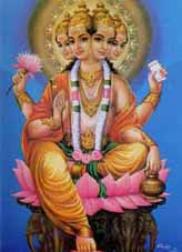
Lord Brahma is one of the gods of Hindu Trinity. He is the Creator. The Lord has in his four hands a water-pot, a manuscript, a sacrificial implement and a rosary. The lotus represents the Reality. Brahma sitting on the lotus indicates that he is ever-rooted in the infinite Reality. The four faces of Brahma represent the four Vedas. They also represent the functioning of the inner personality which consists of thoughts. He is also the only Hindu deity without any weapon in his hands.
According to Puranas, he was born (without a mother) in the lotus which grows from the navel of Vishnu at the beginning of the universe. This explains his name Nabhija (born from the navel). Another legend says that Brahma created himself by first creating water. In this he deposited a seed that later became the golden egg from which he was born as Hiranyagarbha. The remaining materials of this golden egg expanded into the Brahmanda or Universe. Being born in water, Brahma is also called Kanja (born in water). Brahma is said also to be the son of the Supreme Being, Brahman and his female energy, Maya.
Of all the Hindu deities only Brahma is not worshipped like the other deities. Various Puranas assign different reasons for this. The spiritual reason may be because the idea of creation is repugnant to seekers of Truth. According to them, the creation of thoughts has veiled the infinite Reality.
There are only two temples dedicated to Brahma in India, the more prominent of which is at Pushkar, close to Jaipur. Once a year, on the full moon night of the Hindu lunar month of Kartikai (October - November), a religious festival is held in Brahma’s honor. Thousands of pilgrims come to bathe in the holy lake adjacent to the temple. There is also a famous murti of Brahma at Mangalwedha, 52 km from Solapur district in Maharashtra. There is one more temple for Brahma in the temple town of Kumbakonam, (Thanjavur District) Tamil Nadu. Regular pujas are held for Brahma and during Navarathri; this temple comes to life with colorful festivities.
Of the Hindu Trinity, Brahma is the only God whose age or life span is given accurately in the Vedas. His life span is 100 years (Brahmic years) which is equivalent to 314 trillion human years. After Brahma’s end, Shiva dances, all things including Brahma dissolve and nothing exists for an equivalent time, then it all begins again.
Further calculations based on Vedic reference say that is almost "noon" on Lord Brahma's fiftieth "birthday." The subject of time of creation of universe and its end is an interesting subject by itself and it would later be covered under a separate article. Vedas also say that Brahma is born and dissolved along with the universe. Since he is born and meets the end like any other life forms, it may also be one of the reasons he is not worshipped.
At the beginning of the process of creation, Brahma created ten Prajapatis who are believed to be the fathers of the human race. The Manusmriti enumerates them as Marichi, Atri, Angirasa, Pulastya, Pulaha, Kratu, Vasishtha, Prachetas or Daksha, Bhrigu, and Narada. He is also said to have created the seven great sages or the Saptarishis to help him create the universe. However since all these sons of his were born out of his mind rather than body, they are called Manasa Putras or mind-sons.
Since we all descended from Brahma, he becomes the great grand father of all of us. Let us devote a few moments of respect for this grandfather who is the keeper of our invaluable Vedas.
Submit feedback to newsletter@mahaganapati.org with subject line as <Deity of the Month> Disclaimer: Views of readers/column writers are that
of their own and not necessarily of the Temple
