Vageesh Express



Significance
of the Month of September in Hindu Calendar


The
month of Aashwina (September - October) commences with the celebrations of
Mahalaya on September 22 2006, Navaratri which begins on September 23 2006 and
Durga Puja which begins (Maha Saptami) on September 29 2006 and Vijaya
Dashami/Dusshera on October 2 2006.
The Significance of Maha Navaratri
Navaratri is a joyous festival celebrated every year by
Hindus, during early fall season (occurs during late September and early
October). The Goddess in the form of the Universal Mother is worshiped for nine
nights and hence the name *nava-ratri.' On the tenth day, the festival comes to
an end with a special puja called Vijaya Dasami. During the ten days of the
Dussera festival (ten days and nine nights), it is common for Hindus to read
and recite slokas on the greatness of Mother Durga, Lakshmi and Saraswati.
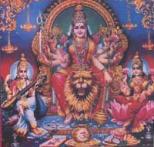
Mother Durga symbolizes the power of purposeful action (Kriya Sakti). Lakshmi represents the will power (Itchaa Sakti) and Saraswati stands for
the power of knowledge (Jnana Sakti).Mahalaya
is an auspicious occasion observed seven days before the Durga Puja, and
heralds the advent of Durga, the goddess of supreme power. It is an invocation to the mother goddess to
descend on earth.
Why
nine nights? Navaratri is divided into sets of three days to adore different
aspects of the supreme goddess. On the
first three days, the Mother is invoked as powerful force called Durga in order to destroy all our
impurities, vices and defects. The next
three days, the Mother is adored as a giver of spiritual wealth, Lakshmi, who is considered to have the
power of bestowing on her devotees the inexhaustible wealth. The final set of three days is spent in
worshipping the mother as the goddess of wisdom, Saraswati. In order have all-round success in life, we need the
blessings of all three aspects of the divine mother; hence, the worship for
nine nights.
Significance of
celebrating the Goddess or the Universal Mother
During Navaratri, we invoke the energy aspect of Goddess
"Durga". She is also referred to as "Devi" (goddess) or
"Shakti" (energy or power). It is this energy, which helps with the
work of creation, preservation and destruction. Worship of Shakti re-confirms the
scientific theory that energy is imperishable. It cannot be created or
destroyed. The worship of the Mother Goddess dates back to the
most ancient Indian traditions. One sees the worship of Bhagawati in Kerala, Renuka Parameswari elsewhere in
South India, Manasi Devi in
North India, Kali in Bengal and so on. Mythological and
Vedic variations of this oft repeated theme of Shakti appear in the form of Parvati, Durga, Lakshmi and Saraswati. It is also believed that Rama worshipped
Durga for nine nights prior to killing Ravana on Vijaya Dasami, and hence the autumnal
Navaratri. The spring
Navaratri commences with Ugadi or Gudi Padva and concludes on
Rama Navami -
Rama's birthday.
Celebration of Maha Navaratri - The Divine Nine Nights -
Navaratnas!
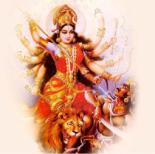 Devi Durga - Durga
is regarded as the invincible power of nature and is associated with the
legend of the destruction of the demon Mahishasura. It was
only nature's unbridled energy that could conquer the demon. Brahmi, Vaishnavi, Shivani, Narasimhani, Vaaraahi, Kaumaari and Indraayani-the seven of these Shaktis are collectively
known as the Sapta Maatas, or the seven mothers. Durga armed
herself with Shiva's trident, Vishnu's discus and mace, Kumaraa's spear and
Indra's thunderbolt. The name “Durga” means “inaccessible,” and she is the
personification of the active side of the divine “saakti” energy of Lord Shiva.
In fact, she represents the furious powers of all the male Gods and is the
ferocious protector of the righteous, and destroyer of the evil. Durga is
usually portrayed as riding a lion, and carrying weapons in her many arms.
Devi Durga - Durga
is regarded as the invincible power of nature and is associated with the
legend of the destruction of the demon Mahishasura. It was
only nature's unbridled energy that could conquer the demon. Brahmi, Vaishnavi, Shivani, Narasimhani, Vaaraahi, Kaumaari and Indraayani-the seven of these Shaktis are collectively
known as the Sapta Maatas, or the seven mothers. Durga armed
herself with Shiva's trident, Vishnu's discus and mace, Kumaraa's spear and
Indra's thunderbolt. The name “Durga” means “inaccessible,” and she is the
personification of the active side of the divine “saakti” energy of Lord Shiva.
In fact, she represents the furious powers of all the male Gods and is the
ferocious protector of the righteous, and destroyer of the evil. Durga is
usually portrayed as riding a lion, and carrying weapons in her many arms.
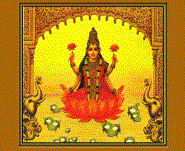 Devi
Lakshmi - symbolizes the benevolent
aspect of nature. Worshipped as the consort of Vishnu, Lakshmi is the symbol of
prosperity and well being. The word 'Lakshmi' is derived from the Sanskrit word
Laksya, meaning 'aim' or 'goal', and she is the goddess of wealth and
prosperity, both material and spiritual. She is said to represent everything
that is beautiful and bountiful in nature and is the source of power, pleasure
and prosperity. She is depicted as a beautiful woman of golden complexion, with
four hands, sitting or standing on a full-bloomed lotus and holding a lotus
bud, which stands for beauty, purity and fertility. Her four hands represent
the four ends of human life: dharma or righteousness, kama or desires,
artha or wealth, and moksha or liberation from the cycle of birth
and death.
Devi
Lakshmi - symbolizes the benevolent
aspect of nature. Worshipped as the consort of Vishnu, Lakshmi is the symbol of
prosperity and well being. The word 'Lakshmi' is derived from the Sanskrit word
Laksya, meaning 'aim' or 'goal', and she is the goddess of wealth and
prosperity, both material and spiritual. She is said to represent everything
that is beautiful and bountiful in nature and is the source of power, pleasure
and prosperity. She is depicted as a beautiful woman of golden complexion, with
four hands, sitting or standing on a full-bloomed lotus and holding a lotus
bud, which stands for beauty, purity and fertility. Her four hands represent
the four ends of human life: dharma or righteousness, kama or desires,
artha or wealth, and moksha or liberation from the cycle of birth
and death.
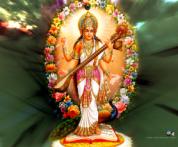 Devi
Saraswati - symbolizes knowledge
and wisdom. Saraswati is regarded as the consort of the creator Bhrahma. All
forms of art are said to originate from Saraswati. Saraswati represents
consciousness and wisdom. Saraswati is also regarded as Vaagdevi,
the goddess of sound and speech. Saraswati is revered as the dispeller of chaos
and confusion. She is depicted as clothed in white,
seated on a white lotus playing the instrument veena. The four vedas are
considered to be her offsprings. Her mount, the swan is said to personify pure
knowledge. Any institution of learning is regarded as Saraswati's temple.
Musical instruments are also regarded as symbols of Saraswati. Legend has it
that Bhrahma the creator acquired the power to think and create only through
the power of Saraswati and that it was Saraswati that enabled Bhrahma to listen
to the Naadabhrahmam the primordial sound which is revered
as the source of all creation. Saraswati is also referred to as Sarada;
the fountainhead of knowledge who leads seekers from darkness to light and from
ignorance to spiritual upliftment.
Devi
Saraswati - symbolizes knowledge
and wisdom. Saraswati is regarded as the consort of the creator Bhrahma. All
forms of art are said to originate from Saraswati. Saraswati represents
consciousness and wisdom. Saraswati is also regarded as Vaagdevi,
the goddess of sound and speech. Saraswati is revered as the dispeller of chaos
and confusion. She is depicted as clothed in white,
seated on a white lotus playing the instrument veena. The four vedas are
considered to be her offsprings. Her mount, the swan is said to personify pure
knowledge. Any institution of learning is regarded as Saraswati's temple.
Musical instruments are also regarded as symbols of Saraswati. Legend has it
that Bhrahma the creator acquired the power to think and create only through
the power of Saraswati and that it was Saraswati that enabled Bhrahma to listen
to the Naadabhrahmam the primordial sound which is revered
as the source of all creation. Saraswati is also referred to as Sarada;
the fountainhead of knowledge who leads seekers from darkness to light and from
ignorance to spiritual upliftment.
Dussera or Vijayadasami
 The 10th
day of navratri is Dussera or Vijayadashmi. Besides Bengal and Central India,
Dussera Parva is celebrated in other Indian states with equal zeal and
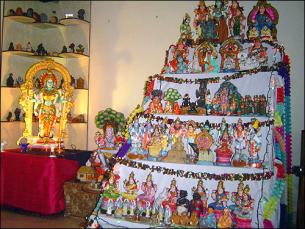
enthusiasm though with regional differences. The women and children of Tamil
Nadu, Andhra Pradesh and Karnataka
arrange dolls known as Bommai Kolu on
steps and decorate the steps and the nearby place with beautiful lamps and
flowers. Traditionally, only women take part in the festivities, exchange gifts
comprising of coconuts, clothes and sweets and visit their friends and
acquaintances during these 10 days. On the tenth night after the ceremonial
aarti and prayers the, `Marapachi'
dolls are put to sleep. On Vijayadasami day, the dolls are taken down. This day
is also considered auspicious for children to begin their education in
classical dance and music. Children also pay homage to their teachers on this
day.
The 10th
day of navratri is Dussera or Vijayadashmi. Besides Bengal and Central India,
Dussera Parva is celebrated in other Indian states with equal zeal and
enthusiasm though with regional differences. The women and children of Tamil
Nadu, Andhra Pradesh and Karnataka
arrange dolls known as Bommai Kolu on
steps and decorate the steps and the nearby place with beautiful lamps and
flowers. Traditionally, only women take part in the festivities, exchange gifts
comprising of coconuts, clothes and sweets and visit their friends and
acquaintances during these 10 days. On the tenth night after the ceremonial
aarti and prayers the, `Marapachi'
dolls are put to sleep. On Vijayadasami day, the dolls are taken down. This day
is also considered auspicious for children to begin their education in
classical dance and music. Children also pay homage to their teachers on this
day.
Dussera
is welcomed in Punjab after nine days of fasting during Navratri, while Garba dance and music reigns the
evenings and nights of Gujarat during the ten days of the festival.
Here, the women dance to the tunes of the rhythmic clapping of hands around an
earthen lamp, singing devotional songs in the honor of the Mother Goddess. Ram
Lila is the backbone of the celebration in Northern India, where scenes from
Rama's life are depicted. In Himachal Pradesh's Kulu valley, the mass
ceremonial festivities and grand processions of the village deities of the hill
people marks Dussera; while Mysore is famous for a gala procession of
richly bedecked elephants on the brightly lit streets of the city.
Significance of Karwa Chauth
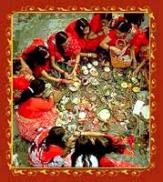
'Karwa Chauth' is a
ritual of fasting observed by married Hindu women seeking the longevity,
well-being and prosperity of their husbands. It is popular amongst married
women in the northern and western parts of India, especially, Haryana, Punjab,
Rajasthan, Uttar Pradesh and Gujarat. This festival comes 9 days before Diwali
on 'kartik ki chauth', i.e., on the fourth day of the new moon immediately
after Dussera, in the month of 'Karthik' (October-November). The term 'Chauth'
means the 'fourth day' and 'Karwa' is an earthen pot with a spout - a symbol of
peace and prosperity - that is necessary for the rituals. Hence the name 'Karwa
Chauth'.
The Ritual and Fast
 By legend on the occasion of this vrat (Fast) a
kalash (small container) is filled with either milk or water. In that kalash is
placed Pancha Ratna (five pieces of different metals gold, silver, copper,
brass and iron). The kalash is then presented to a Brahmin and also exchanged
with other married women. While thus presenting the kalash, a wishful prayer is
offered to Lord Ganesh: "Let the offerings of this Karva (Karak (gift
bring long life to my husband and may my saubhagya be everlasting". And
express such desire that ‘May my death precede that of my husband so that I can
enter the chitaa (funeral pyre) as a bride (not as a widow).
By legend on the occasion of this vrat (Fast) a
kalash (small container) is filled with either milk or water. In that kalash is
placed Pancha Ratna (five pieces of different metals gold, silver, copper,
brass and iron). The kalash is then presented to a Brahmin and also exchanged
with other married women. While thus presenting the kalash, a wishful prayer is
offered to Lord Ganesh: "Let the offerings of this Karva (Karak (gift
bring long life to my husband and may my saubhagya be everlasting". And
express such desire that ‘May my death precede that of my husband so that I can
enter the chitaa (funeral pyre) as a bride (not as a widow).
This katha (narrative) first took
place between Siva and parvati. Siva told Parvati about the significance of
Karva Vrat. In Dwapar Yuga, Draupadi asked Lord Krishna about the vrat of Karva
Chauth. Thereafter, the very first time this vrat was observed in the town of
Shukraprastha by Veeravati, the daughter of Vedsharma and Leelavati. Ever
since, this vrat has been observed by married women.
Married women keep a
strict fast and do not take even a drop of water. They get up early in the
morning, perform their ablutions, and wear new and festive raiment. Shiva,
Parvati and their son Kartikeya are worshipped on this day along with the 10
'karwas' (earthen pots) filled with sweets. The Karwas are given to daughters
and sisters along with gifts. It is the
most important and difficult fast observed by married Hindu women. (Unmarried
women, widows, and spinsters are barred from observing this fast.) It begins
before sunrise and ends only after offering prayers and worshipping the moon at
night. Women from all over the neighborhood gather in a group and narrate
stories that tell the significance of Karwa Chauth.
Sources:
http://www.bawarchi.com/festivals
Submit feedback to newsletter@mahaganapati.org with subject line as <Reader Articles: September Significance> Disclaimer: Views of readers/column writers are that
of their own and not of the Temple
