Vageesh Express


Readers Articles

Significance of the
Month of January in Hindu Calendar
The
Hindu
month of Maargasira - Pushya commences
with the celebrations of Makara Sankranthi/Pongal and Vasanth Panchami
Significance Makarsankranthi/Pongal!
 According to the lunar calendar, the sun moves from the Tropic of Cancer
to the Tropic of Capricorn or from Dakshinayana to Uttarayana, in the month of
Poush in mid-January. This end of the winter solstice also coincides with the
harvest season and cessation of the northeast monsoon in South India. The
movement of the earth from one zodiac sign into another is celebrated as
Sankranti, or Lohri, in the North, Pongal in the South, 'Bhogali Bihu' in the North Eastern State of Assam,
'Lohri' in Punjab, 'Bhogi' in Andhra Pradesh and 'Makar Sankranti' in the rest
of the country, including Karnataka, Maharashtra, Uttar Pradesh, Bihar and
Bengal. Assam's 'Bihu' involves the
early morning worship of Agni, the god of fire followed by a nightlong feast
with family and friends. Bengal's 'Makar Sankranti' entails the preparation of
traditional rice-sweets called 'Pittha' and the holy fair - Ganga Sagar Mela at
the Ganga Sagar beach.
According to the lunar calendar, the sun moves from the Tropic of Cancer
to the Tropic of Capricorn or from Dakshinayana to Uttarayana, in the month of
Poush in mid-January. This end of the winter solstice also coincides with the
harvest season and cessation of the northeast monsoon in South India. The
movement of the earth from one zodiac sign into another is celebrated as
Sankranti, or Lohri, in the North, Pongal in the South, 'Bhogali Bihu' in the North Eastern State of Assam,
'Lohri' in Punjab, 'Bhogi' in Andhra Pradesh and 'Makar Sankranti' in the rest
of the country, including Karnataka, Maharashtra, Uttar Pradesh, Bihar and
Bengal. Assam's 'Bihu' involves the
early morning worship of Agni, the god of fire followed by a nightlong feast
with family and friends. Bengal's 'Makar Sankranti' entails the preparation of
traditional rice-sweets called 'Pittha' and the holy fair - Ganga Sagar Mela at
the Ganga Sagar beach.
The word pongal,
in both Telugu and Tamil, signifies the boiling over of the rice in the cooking
pot. As the cycle of season rings out the
old and ushers in the new, so is the advent of Pongal connected with cleaning
up the old, burning down rubbish, and welcoming in new crops. Though little is known about the origin of
Pongal, it is probably a Dravidian harvest festival that has survived for
millennia. The Sankranti season ends with Ratha Saptami, the seventh day of the
bright half of Magha, when the sun and his golden chariot are honored. Pongal
is a four-day festival.
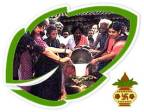 Day 1: Bhogi
Pongal - Bhogi Pongal is a day for the
family, for domestic activities and of being together with the members of the
household. This day is celebrated in honor of Lord Indra, "the Ruler of
Clouds and Giver of Rains". On the first day of Pongal a huge bonfire is
lit at dawn in front of the house and all old and useless items are set ablaze,
symbolic of beginning a fresh new year. The bonfire burns through the night as
young people beat little drums and dance around it. Homes are cleaned and the house is whitewashed and
decorated with "Kolam" -
floor designs drawn in the white paste of newly harvested rice with outlines of
red mud. Often pumpkin flowers are set into cow-dung balls and placed among the
patterns. Fresh harvest of rice, turmeric and sugarcane is brought in from the
field as preparation for the following day.
Day 1: Bhogi
Pongal - Bhogi Pongal is a day for the
family, for domestic activities and of being together with the members of the
household. This day is celebrated in honor of Lord Indra, "the Ruler of
Clouds and Giver of Rains". On the first day of Pongal a huge bonfire is
lit at dawn in front of the house and all old and useless items are set ablaze,
symbolic of beginning a fresh new year. The bonfire burns through the night as
young people beat little drums and dance around it. Homes are cleaned and the house is whitewashed and
decorated with "Kolam" -
floor designs drawn in the white paste of newly harvested rice with outlines of
red mud. Often pumpkin flowers are set into cow-dung balls and placed among the
patterns. Fresh harvest of rice, turmeric and sugarcane is brought in from the
field as preparation for the following day.
Day
2: Surya Pongal - The second day is
dedicated to Lord Surya, the Sun God, who is offered boiled milk and jaggery. A
plank is placed on the ground, a large image of the Sun God is sketched on it
and Kolam designs are drawn around it. This icon of the Sun God is worshipped
for divine benediction as the new month of 'Thai'
begins.
Day
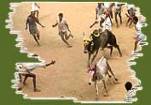
3: Mattu Pongal - The third day is meant
for the cattle ('mattu') - the giver of milk and puller of the plough. The
farmer's “friends” are given a good bath, their horns are polished, painted and
covered with metal caps, and garlands are put around their necks. The pongal
that has been offered to the gods is then given to the cattle to eat. They are
then taken out to the racing tracks for cattle race and bullfight - an event
full of festivity, fun, frolic and revelry. According to another legend
associated with Mattu Pongal, the third day of celebrations, Lord Shiva once
asked his Nandi bull to go to earth and deliver a special message to his
disciples: "Have an oil bath everyday, and food once a month." But the baffled bovine failed to deliver the
correct message. He told the people that Shiva asked them to "have an oil
bath once a month, and food everyday." The enraged Shiva then ordered
Nandi to stay back on earth and help the people plough the fields, since they
would now need to grow more grains.
 Day 4: Kanya
Pongal - The fourth and final day marks
the Kanya Pongal, when birds are worshipped. Girls prepare colored balls of cooked
rice and keep them in the open for birds and fowls to eat. On this day sisters
also pray for their brothers' happiness.
Day 4: Kanya
Pongal - The fourth and final day marks
the Kanya Pongal, when birds are worshipped. Girls prepare colored balls of cooked
rice and keep them in the open for birds and fowls to eat. On this day sisters
also pray for their brothers' happiness.
In Punjab, people celebrate Lohri by feasting on
sweets made of jaggery, peanuts and sesame seeds, and making a symbolic bonfire
of the departing winter. In the days leading up to Lohri, children visit homes
of neighbours, sing traditional Lohri songs, and ask for coins and sweets in
return. In Gujarat and other western states, people observe Uttarayana, when
the winds change, by flying kites. The winter sky bursts into colour with
thousands of paper kites. The festivities conclude with a winter feast.
In Maharashtra, people dress in new clothes and
distribute sesame sweets. New brides are welcomed into the family with sugar
ornaments and a turmeric-and-vermilion ceremony. In rural Maharashtra, feasts
of the new harvest mark the festival. In Assam people celebrate the paddy
harvest in winter with Magha or Bhogali Bihu. Pavilions with thatched roofs
come up in the villages and there is feasting in the night. The pavilions are
set afire in the morning. The festivities continue for a week. At Ganga Sagar,
where the Ganga enters the sea, a grand fair is held. The festival is also
called Til Sankranti or Kichri Sankranti, after its main ingredient or
preparation.
Significance Vasanth Panchami – The Spring Festival!
 As 'Diwali' - the
festival of light – is to Lakshmi, goddess of wealth, and 'Navaratri' is to
Durga, goddess of strength, might and power, Vasant Panchami is to Saraswati,
the goddess of knowledge and learning. She is the mother of the Vedas, and
chants to her, called the 'Saraswati Vandana' often begin and end Vedic
lessons. Vasant Panchami is also known as Shri Panchami. As Saraswati Puja, it
is observed religiously almost in all parts of India expecially in Bengal.
Goddess Saraswati being pure and white and representing learning, free flow of
wisdom and consciousness
As 'Diwali' - the
festival of light – is to Lakshmi, goddess of wealth, and 'Navaratri' is to
Durga, goddess of strength, might and power, Vasant Panchami is to Saraswati,
the goddess of knowledge and learning. She is the mother of the Vedas, and
chants to her, called the 'Saraswati Vandana' often begin and end Vedic
lessons. Vasant Panchami is also known as Shri Panchami. As Saraswati Puja, it
is observed religiously almost in all parts of India expecially in Bengal.
Goddess Saraswati being pure and white and representing learning, free flow of
wisdom and consciousness
The festival is celebrated every year on the 5th day of
the bright fortnight of the lunar month of Magha. Hindus celebrate this
festival with great enthusiasm, and temples and households are full of
activities on this day. This 'Panchami' is also known as Saraswati Day, because
it is believed that on this day the goddess was born.
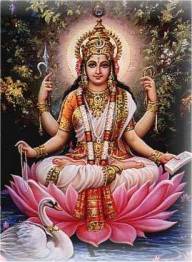
Saraswati, the goddess of wisdom, art and music is the
daughter of Lord Shiva and Goddess Durga. It is believed that goddess Saraswati
endows human beings with the powers of speech, wisdom and learning. She has
four hands representing four aspects of human personality in learning: mind, intellect,
alertness and ego. She has sacred scriptures in one hand and a lotus - the
symbol of true knowledge - in the second. With her other two hands she plays
the music of love and life on a string instrument called the veena. She is
dressed in white - the symbol of purity - and rides on a white swan that
symbolises Sattwa Guna or purity and discrimination. Saraswati is also a
prominent figure in Buddhist iconography - the consort of Manjushri.
The color yellow is given special importance on Vasant
Panchami. On this day, Saraswati is dressed in yellow garments and worshipped. Sweetmeats
of yellow hues are distributed among relatives and friends. Some people feed
Brahmins, some perform Pitru-Tarpan
(ancestor worship) and many worship Kamadeva, the god of love on this day.
However, the most significant aspect of this day is that
children are taught their first words on this day, for it is considered an
auspicious day to begin how to read and write. In the South, a similar practice
is prevalent during Vijayadasami, the 10th day of the Navaratri
festival. Educational institutions organize special prayers for Saraswati. The
great Indian guru Pandit Madan Mohan Malviya laid the foundations of the Kashi
Hindu Vishwa Vidyalaya on Vasant Panchami. Vasant Panchami is a festival full
of religious, seasonal and social significance and is celebrated by Hindus all
over the world with verve and new sense of optimism. The first faint signals of
the forthcoming festival of Holi – the festival of colours — also manifest at
Vasant Panchami.
Sources:
http://hinduism.about.com
Submit feedback to newsletter@mahaganapati.org with subject line as <Reader Articles> Disclaimer: Views of readers/column writers are that
of their own and not of the Temple
