Vageesh Express


Readers Articles

Significance of the
Month of July in Hindu Calendar
The day of full moon - Purnima, in the month of July - Ashadh is
traditionally celebrated as Guru Purnima/Ashada Purnima and Rath Yatra
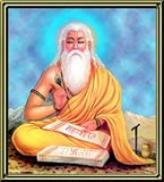
The day of full moon, Purnima, in the month of Ashadh is traditionally celebrated as Guru Purnima by Hindus and it falls on 29th July (guruvar). Also known as Vyas Purnima, the day is celebrated in remembrance and veneration to sage Ved Vyasa. He is the Aadi (original) Guru of the Hindu Dharma. On this memorable day, Sri Vyasa, one of the Chiranjeevis, an incarnation of Lord Vishnu, began to write his unique Brahma Sutras or Vedanta Sutras and Mahabharata All Hindus are indebted to this ancient saint who edited the four Vedas, wrote the eighteen Puranas, the Mahabharata and the Srimad Bhagavata. Vyasa even taught Dattatreya, who is regarded as the Guru of Gurus. On this day, the Guru is offered Puja (worship) by the disciples. Hindus attach paramount importance to spiritual gurus. Gurus are often equated with God and always regarded as a link between the individual and the Immortal. Just as the moon shines by reflecting the light of the sun, and glorifies it, all disciples can dazzle like the moon by gaining from their Gurus.
The Need of
a Guru
Hindus glorify Guru by chanting this famous verse,
known by heart by all Hindu children which glorifies the Guru:
Gurubrahma Guruvishnu
Gururdevo Maheshwaraha |
Guruhu sakshaat Parambrahman tasmai Shrigurave namaha ||
The Sanskrit root “Gu” means darkness or ignorance. "Ru" denotes the remover of that darkness. Therefore one who removes darkness of our ignorance is a Guru. Only he who removes our ultimate darkness, known as Maya, and who inspires and guides us on to the path of God-realization is the true Guru. Students also refer to their school teacher or college lecturer as guru. The connotation of the word ‘Guru’ is in this case is the one who imparts temporal knowledge (Apara Vidhya) and is thus accordingly offered respect. A spiritual aspirant, no matter how brilliant, can never attain such knowledge by his own endeavor. In essence, one can only attain salvation by serving the satpurush. Treading the path to God-realization by one's own efforts is likened by the Katha Upanishad as walking on a razor's edge. Aadi Shankaracharya’s words: "If a person, despite possessing: a handsome, disease-free body, fame, a mountain of wealth, and even if he has studied the Vedas and all other scriptures, and has himself composed many scriptures, but has not surrendered himself at the feet of a Guru, then he has achieved nothing, nothing, nothing, nothing."
The
Significance of Guru Purnima!
 On
this Guru Purnima day, all spiritual aspirants and devotees worship Vyasa in
honor of his divine personage and all disciples perform a puja of their
respective spiritual preceptor or 'Gurus'. It is said that - The aspirant
should offer equal and intensely loving service to God and His sadhu. Then,
despite being the lowest type of devotee who is destined to become a
great-devotee after either two births or four births or ten births or even a
hundred births, he can become a great devotee in this birth. Such is the fruit
of serving God and His sadhu equally. The Guru plays a vital role in boosting
the aspirant frequently, when he loses track, becomes despondent or simply runs
out of steam. The aspirant is thus better able to obey the Guru if he
understands the Guru's glory.
On
this Guru Purnima day, all spiritual aspirants and devotees worship Vyasa in
honor of his divine personage and all disciples perform a puja of their
respective spiritual preceptor or 'Gurus'. It is said that - The aspirant
should offer equal and intensely loving service to God and His sadhu. Then,
despite being the lowest type of devotee who is destined to become a
great-devotee after either two births or four births or ten births or even a
hundred births, he can become a great devotee in this birth. Such is the fruit
of serving God and His sadhu equally. The Guru plays a vital role in boosting
the aspirant frequently, when he loses track, becomes despondent or simply runs
out of steam. The aspirant is thus better able to obey the Guru if he
understands the Guru's glory.
This day is of deep significance to the farmers, for it heralds the setting in of the much-needed rains, as the advent of cool showers usher in fresh life in the fields. It is a good time to begin your spiritual lessons. Traditionally, spiritual seekers commence to intensify their spiritual 'sadhana' from this day. The period 'Chaturmas' ("four months") begins from this day. In the past, wandering spiritual masters and their disciples used to settle down at a place to study and discourse on the Brahma Sutras composed by Vyasa, and engage themselves in Vedantic discussions.
It was not without reason that the India of the past carefully tended and kept alive the lamp of Guru-Tattva. It is therefore not without reason that India, year after year, age after age, commemorates anew this ancient concept of the Guru, adores it and pays homage to it again and again, and thereby re-affirms its belief and allegiance to it. For, the true Indian knows that the Guru is the only guarantee for the individual to transcend the bondage of sorrow and death, and experience the Consciousness of the Reality.
The Guru’s Message: What to observe on this day
The great Swami Sivananda advice: "Wake up at Brahmamuhurta (at 4 a.m.) on this most holy day. Meditate on the lotus feet of your Guru. Mentally pray to him for his Grace, through which alone you can attain Self-realization. Do vigorous Japa and meditate in the early morning hours. After bath, worship the lotus feet of your Guru, or his image or picture with flowers, fruits, incense and camphor. Fast or take only milk and fruits the whole day and practice rigorous Dhyana. Worship your Guru and feed the Mahatmas, Sadhus and the poor. In the afternoon, sit with other devotees of your Guru and discuss with them the glories and teachings of your Guru. Alternatively, you may observe the vow of silence and study the books or writings of your Guru, or mentally reflect upon his teachings. Take fresh resolves on this holy day, to tread the spiritual path in accordance with the precepts of your Guru. At night, assemble again with other devotees, and sing the Names of the Lord and the glories of your Guru. The best form of worship of the Guru is to follow his teachings, to shine as the very embodiment of his teachings, and to propagate his glory and his message."
You will be highly benefited on this day by Guru or Isvara Himself. Guru is your real father, mother, friend, guide and savior. The Grace of the Guru is indispensable for the spiritual progress of the aspirants. The Sruti says, “To that high-souled aspirant whose devotion to the Lord is great and whose devotion to his Guru is as great as that to the Lord, these secrets explained become illuminated.” Brahman or the Supreme Self alone is real. He is the Soul of all. He is All in all. He is the Essence of this universe. He is the Unity that never admits of a duality under all the varieties and diversities of nature. Thou art this Immortal, All-pervading, All-blissful Brahman. Thou art That. Realize this and be free - Tat Tvam Asi.
Therefore on the day of Guru Purnima, disciples introspect, and resolve to offer Puja and reverence to the Guru in mind, action and speech; implicitly obey his unvoiced wishes, commands, serving him as one would God and lauding his glory and redemptive attributes.
The
Significance of Rath Yatra or the Chariot Festival!
God goes on a Vacation
The Chariot Festivals of India
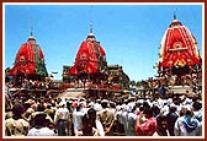
Every year in mid-summer, Lord Jagannath, with his elder brother Balabhadra and sister Subhadra, goes on vacation, traveling on grand chariots, from his temple in Puri, to his garden palace in the countryside. This belief of the Hindus has given rise to one of the biggest religious festivals in India - the Rathyatra or the Chariot Festival. This is also the etymological origin of the English word 'Juggernaut'.Jagannath, believed to be an avatar of Lord Vishnu, is the Lord of Puri — the coastal town of Orissa in eastern India.
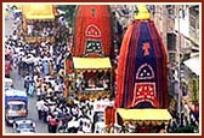
Rathyatra is of great significance to the Hindus, and especially to the people of Orissa. It is during this time that the three deities of Jagannath, Balabhadra and Subhadra are taken out in a grand procession in specially made gigantic temple-like chariots called raths, which are pulled by thousands of devotees. Every year on the auspicious day of Aashaada, in end June or early July, Hindus celebrate the Rath Yatra festival. Rath means chariot, Yatra - a pilgrimage or procession. Though this festival is celebrated all over India, it originated in Jagannath Puri on the eastern coast
There are several stories which
signify the Festival but the most commonly narrated one is this story, concerns
about what happened after the cremation of Lord Krishna's mortal body.
When Shri Krishna was being cremated in Dwaraka, Balaram, overcome with grief,
dashed into the ocean with Shri Krishna's partially cremated body. Subhadra
too, followed both the brothers. At the same time, on the eastern shore of
India, King Indradyumna of Jagannath Puri had a dream that the Lord's body
would float up to the shores of Puri. He should build a huge mandir in the city
and consecrate the wooden murtis of Shri Krishna, Balaram and Subhadra. The
bones (asthi) of Lord Krishna's body should be placed in the hollow in the back
of the murti. The dream came true. He found the splinters of bone (asthi) and
took them. But the question was who would carve the murtis. It is said that the
architect of the gods - Vishwakarma - arrived as an old carpenter. He
stipulated that while carving the murtis nobody should disturb him and if
anybody did, he would stop work and leave.
A few months elapsed. Driven
with impatience, Indradyumna opened the door of Vishwakarma's room, who
vanished instantly as he had stipulated. Despite the incomplete murtis, the
king consecrated them, placing the holy cinders of Lord Krishna in the hollow
of the murti and installed them in the mandir. Every year a grand procession is
carried out with the murtis of Lord Krishna, Balaram and Subhadra in three
gigantic floats. The floats are pulled by devotees from Janakpur to the mandir
in Jagannath Puri. The murtis are changed every twelve years, the new ones
being incomplete too.
The Jagannath Mandir in Jagannath Puri is one of the four most sacred mandirs
in the four directions of the Indian sub - continent. The other three are:
Rameshwar in South, Dwarka in West and Badrinath in the Himalayas. Probably the
mandir in Jagannath Puri is the only mandir in the world housing murtis of
three deities who are siblings - Lord Krishna, Balaram and Subhadra.
The festival is of utmost important in these places.
The
Puri Rathyatra
The Puri Rathyatra is world famous for the crowd that it attracts. Puri being
the abode of these three deities, the place plays host to devotees, tourists
and about one million pilgrims from across India and abroad. Many artists and
artisans are engaged in building these three chariots, weaving its fabric
covers that dress up the chariots, and painting them in the right shades and
motifs to give them the best possible looks. Fourteen tailors are engaged in
stitching up the covers that require almost 1,200 metres of cloth. Orissa's
government-run textile mill usually supply the cloth needed to decorate the
chariots. However, other Bombay-based Century Mills also donate cloth for the
Rathyatra.
Rathyatra
of Ahmedabad
The Rathyatra of Ahmedabad stands next to the Puri festival in grandeur and
crowd-pulling. Nowadays, there are not just the thousands of people who
participate in the Ahmedabad event, there are also communication satellites
which the police use under the global positioning system to chart the course of
the chariots on a map on the computer screen to monitor them from a control
room. This is because Ahmedabad Rathyatra has a bloody record. The last violent
Rathyatra which the city saw was in 1992, when the city suddenly became
surcharged with communal riots
Rathyatra
of Mahesh
The Rathyatra of Mahesh in the Hoogly district of West Bengal is also of
historical repute. This is not only because it's the grandest and the oldest
Rathyatras in Bengal, but because of huge congregation it manages to attract.
The Mahesh Rathyatra of 1875 is of special historical significance: A young
girl was lost in the fair and amongst many, the district magistrate Bankim
Chandra Chattopadhya - the great
Bengali poet and author of India's National song - he himself went out to search for the girl. A couple of months
later this incident inspired him to write the famous novel Radharani.
Rathyatra is a great festival because of its ability to unite people in its festivity. All people, rich and poor, equally enjoy the fairs and the joy they bring. It is amazing to know that even Muslims participate in Rathyatras! Muslim residents of Narayanpur, a village of about a thousand families in the Subarnapur district of Orissa, regularly take part in the festival, from building the chariots to pulling the rath

Source: http://hinduism.about.com
Submit feedback to newsletter@mahaganapati.org with subject line as <Reader Articles> Disclaimer: Views of readers/column writers are that
of their own and not of the Temple
