Vageesh Express


Readers Articles
March 2007 Edition

Significance
of the Month of March in Hindu Calendar


The month of March commences with the
festival of exuberant colors ‘Holi’
and a day, more so the beginning of New Year - ‘Ugadi’ and ‘Gudi Padwa’
and spiritual celebration of ‘Ramanavami’
and ends with ‘Mahavir Jayanthi’!
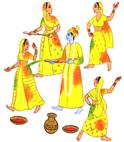
Holi - The Spring Festival of Colors! The
Colors of Joy! Time for a Colorful Rebellion!
With winter mists melting in the sunshine,
Phalgun brings new life to every leaf and bud, announcing that Vasant Ritu or Springtime
has come with its great display of flowers and fruits. While nature wears
verdant new robes, the vernal equinox brings hope to farmers. This joyful new
beginning is celebrated on the full moon day of Phalgun at the most colorful
festival of
The night before the full moon, crowds of
people gather in open spaces and light huge bonfires to burn the residual dried
leaves and twigs of the winter) To fire-god Hutashani, they offer ears of corn,
new vegetables, coconuts, butter, sweets, flowers and vermillion. The Holi
bonfire, often a community event, is also a commemoration of the Puranic legend
- that it derives its name from Holika, thhe daughter of the mythical megalomaniac
king Hiranyakashipu who commanded everyone to worship him. His little son
Prahlada refused to do so and instead he became a devotee of Lord Vishnu. His
father ordered Holika to kill him and she possessing the ability to walk
through fire unharmed, picked up the child and walked into a fire with him.
Prahlada, however, chanted the names of God and was saved. Holika perished
because she did not know that her powers were only effective if she entered the
fire alone. This myth has a strong association with the festival of Holi, the
demoness Holika was burnt to death and the victory of good over evil was once
again ensured. Next morning, when the embers are cold, dhuli or the sacred dust
of the bonfire is venerated. Colored water and powders (gulal and kurnkum) are
thrown over merrymakers to symbolize the coming of spring. Especially in
villages, Holi, also called Phag or Shimga, is an important fortnight-long
celebration during which homes are renovated, painted and planned weddings are
held and feast shared.
Holi is also celebrated in memory of Lord
Krishna. In the legends of Krishna as a youth, he is depicted playing pranks
with the gopis or cowgirls. One prank was to throw colored powder all over
them. So at Holi, images of
Metaphorically,
Ugadi and
Gudi Padwa!
Preparations for the festival begin a week
ahead. Houses are given a thorough wash. Shopping for new clothes and buying
other items that go with the requirements of the festival are done with a lot
of excitement. Ugadi is celebrated with
festive fervor in
It’s
Ugadi in Andhra!
On Ugadi day, people wake up before the break
of dawn and take a head bath after which they decorate the entrance of their
houses with fresh mango leaves. The significance of tying mango leaves relates
to a legend. It is said that Kartik (or Subramanya/Kartikeya) and Ganesha, the
two sons of Lord Siva and Parvathi were very fond of mangoes. As the legend
goes Kartik exhorted people to tie green mango leaves to the doorway signifying
a good crop and general well-being. It is noteworthy that to use mango leaves
and coconuts (as in a Kalasam, to initiate any puja) only on auspicious
occasions to propitiate gods. People also splash fresh cow dung water on the
ground in front of their house and draw colorful floral designs. This is a
common sight in every household. People perform the ritualistic worship to God
invoking his blessings before they start off with the New Year. They pray for
their health, wealth and prosperity and success in business too. Ugadi is also
the most auspicious time to start new ventures. The celebration of Ugadi is
marked by religious zeal and social merriment. Special dishes are prepared for
the occasion. In Andhra Pradesh, eatables such as ‘pulihora’, ‘bobbatlu’ and
preparations made with raw mango go well with the occasion. In Karnataka too,
similar preparations are made but called ‘puliogure’ and ‘holige’.
People in Andhra, believe that Lord Brahma
began the creation of the universe on this auspicious day of Ugadi. People
prepare for the New Year by cleaning and washing their houses and buying new
clothes. On the Ugadi day they decorate their houses with mango leaves and
"rangoli" designs, and pray for a prosperous new year, and visit the
temples to listen to the yearly calendar - "Panchangasravanam" as priests
make predictions for the coming year. Ugadi is also an auspicious day to embark
on any new endeavor.
Bring
in the Goodies on Gudipadwa!
In
The
Significance of Ramanavami, Mahavir Jayanti and Hanuman Jayanti!
Ramanavami or the birthday of Lord Rama is a
major Hindu festival celebrated all over the country by devout Hindus both
Vaishnavas and Shaivas. Lord Rama, the seventh incarnation of Vishnu was born
on the ninth day of the bright half of the Chaitra (March - April) in Ayodhya,
in the Treta Yuga, the Second Age.
There is one God, Desireless, Formless,
Uncreated, True Being, 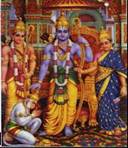 Consciousness and Bliss, the Supreme Spirit, the all
pervading, whose shadow is the world; who incarnates himself as Rama or Krishna
and does many things, only for the love that he bears to his devotees; who in
his mercy ever refrains from anger against those whom he loves and knows to be
his own. Adi Kavi Valmiki in his celebrated Ramayana describes the advent of
Rama thus: "Then after the expiry
of six seasons and on the completion of the twelfth month, on the ninth lunar
day of the month of chaitra under the star Punarvasu, with the Sun, Mars,
Saturn, Jupiter and Venus at Aries, Capricorn, Libra, Cancer and Pisces, and
when the moon with Jupiter entered Cancer of the Zodiac, Kaushalya gave birth
to great and prosperous Rama with mighty arms, rosy eyes and scarlet lips, the
joy of Dashratha and the adored of all people. He bore all auspicious marks on
his fair body. The Ramanavami festival offers to us all an opportunity to
imbibe at least some of the ideas and spirit enshrined in the ways of Rama. On
this great day Lord Rama is prayed to and worshipped, and it is the surest
means to be able to follow in his ideals. One who approaches his lotus feet with
love devotion and humility becomes noble, large hearted, pious, peaceful,
master of senses and beloved of the wise. On this scared day you should observe
fast and practice charities. You should visit a
Consciousness and Bliss, the Supreme Spirit, the all
pervading, whose shadow is the world; who incarnates himself as Rama or Krishna
and does many things, only for the love that he bears to his devotees; who in
his mercy ever refrains from anger against those whom he loves and knows to be
his own. Adi Kavi Valmiki in his celebrated Ramayana describes the advent of
Rama thus: "Then after the expiry
of six seasons and on the completion of the twelfth month, on the ninth lunar
day of the month of chaitra under the star Punarvasu, with the Sun, Mars,
Saturn, Jupiter and Venus at Aries, Capricorn, Libra, Cancer and Pisces, and
when the moon with Jupiter entered Cancer of the Zodiac, Kaushalya gave birth
to great and prosperous Rama with mighty arms, rosy eyes and scarlet lips, the
joy of Dashratha and the adored of all people. He bore all auspicious marks on
his fair body. The Ramanavami festival offers to us all an opportunity to
imbibe at least some of the ideas and spirit enshrined in the ways of Rama. On
this great day Lord Rama is prayed to and worshipped, and it is the surest
means to be able to follow in his ideals. One who approaches his lotus feet with
love devotion and humility becomes noble, large hearted, pious, peaceful,
master of senses and beloved of the wise. On this scared day you should observe
fast and practice charities. You should visit a
Mahavir Jayanthi - The main Jain festival of
the year is Mahavir Jayanti, the birth anniversary of Mahavira, the founder of
Jainism.
According to the Digambara 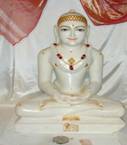 Lord Mahavira was born in the year 615 BC, but the
Swetambaras believe that he was born in 599 BC.
Lord Mahavira was born in the year 615 BC, but the
Swetambaras believe that he was born in 599 BC.
Both sects however agree that he was the son
of Siddhartha and Trisala. Legend has it that he was conceived by Devananda,
wife of a Brahmin named Rishabhdeva. It is believed that the gods, ingeniously,
transferred the embryo to the womb of Trisala. It is said that the expectant
mother had sixteen auspicious dreams before the child was born (only 14
according to the Swetambaras). Astrologers’ interpreting these dreams stated
that the child would be either an emperor or a Teerthankara. This religious
event is largely observed by the Jains by visiting sacred sites and worshipping
the Teerthankara. The event holds special significance in Gujarat and Rajasthan
due to the ancient shrines at Girnar and Palitana in Gujarat. Mahavir Jayanti
is also celebrated at

Source:
http://www.namasthenri.com/fairsandfestivals/ugadi.htm
Submit feedback to newsletter@mahaganapati.org with subject line as <Reader Articles> Disclaimer: Views of readers/column
writers are that of their own and not of the
