Readers
Articles
Significance
of the Month of September in Hindu Calendar
The month of Ashwina (September - October) commences with
two glorious celebrations:
Krishnashtami – Sep 4th and Ganesh Chaturthi –
Sep 15th
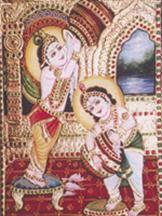
Happy Birthday to Lord Krishna – Krishna
Janmashtami!
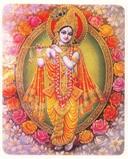
“ I am the conscience in the heart of all creatures
I am their beginning, their being, their
end
I am the mind of the senses,
I am the radiant sun among lights
I am the song in sacred lore,
I am the king of deities
I am the priest of great seers…"
This
is how Lord Krishna describes God in the Holy Bhagavad Gita. And to most
Hindus he is the God himself, the Supreme Being, the Absolute, the Brahman, and
the Purna Purushotam. The great exponent of the Gita, Krishna is the ninth and the complete incarnate of
Vishnu, the Godhead of the Hindu Trinity of deities. Of all the Vishnu avatars
he is the most popular, and perhaps of all Hindu gods the one closest to the
heart of the masses. Krishna has influenced
the Indian thought, life and culture in myriad ways. He has influenced not only
its religion and philosophy, but also into its mysticism and literature,
painting and sculpture, dance and music, and all aspects of Indian folklore. The
birthday of such a favorite deity is bound to be a special occasion for the
Hindus, who consider Krishna their leader,
hero, protector, philosopher, teacher and friend all rolled into one as the
westerners embrace the birth of Lord Jesus.
Birth of the Lord: Krishna took birth at midnight on the ashtami or the
8th day of the Krishnapaksha or dark fortnight in the Hidu month f
Shravan (August-September). This auspicious day is called Janmashthami. The
birth of Krishna is in itself a transcendental
phenomenon that generates awe among the Hindus and overwhelms one and all with
its supra mundane happenings. Mother Earth, unable to bear the burden of sins
committed by evil kings and rulers, appealed to Brahma, the Creator for help.
Brahma prayed to the Supreme Lord Vishnu, who assured him that he would soon be
born on earth to annihilate tyrannical forces. One such evil force was Kamsa,
the ruler of Mathura (in northern India)
and his people were utterly terrified of him. On the day Kamsa's sister Devaki
was married off to Vasudeva, an akashvani or voice from the sky was
heard prophesying that Devaki's 8th son would be the destroyer of Kamsa. The
frightened Kamsa immediately unsheathed his sword to kill his sister but
Vasudeva intervened and implored Kamsa to spare his bride, and promised to hand
over every new born child to him. Kamsa relented but imprisoned both Devaki and
her husband Vasudeva.
 When Devaki gave birth to her first child, Kamsa came to
the prison cell and slaughtered the newborn. In this way, he killed the first
six sons of Devaki. Even before her 8th child was born, Devaki and Vasudeva
started lamenting its fate and theirs. Then suddenly Lord Vishnu appeared
before them and said he himself was coming to rescue them and the people of Mathura. He asked Vasudeva
to carry him to the house of his friend, the cowherd chief Nanda in Gokula
right after his birth, where Nanda's wife Yashoda had given birth to a
daughter. He was to exchange his boy and bring Yashoda's baby daughter back to
the prison. Vishnu assured them that "nothing shall bar your path".
When Devaki gave birth to her first child, Kamsa came to
the prison cell and slaughtered the newborn. In this way, he killed the first
six sons of Devaki. Even before her 8th child was born, Devaki and Vasudeva
started lamenting its fate and theirs. Then suddenly Lord Vishnu appeared
before them and said he himself was coming to rescue them and the people of Mathura. He asked Vasudeva
to carry him to the house of his friend, the cowherd chief Nanda in Gokula
right after his birth, where Nanda's wife Yashoda had given birth to a
daughter. He was to exchange his boy and bring Yashoda's baby daughter back to
the prison. Vishnu assured them that "nothing shall bar your path".
At midnight on ashtami, the divine
baby was born in Kamsa's prison. Remembering the divine instructions, Vasudeva
clasped the child to his bosom and started for Gokula, but found that his legs
were in chains. He jerked his legs and was unfettered! The massive iron-barred
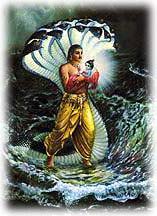
doors unlocked and opened up. While crossing river Yamuna, Vasudeva held his
baby high over his head. The rain fell in torrents and the river was in spate.
But the water made way for Vasudeva and miraculously a five-mouthed snake
followed him from behind and provided shelter over the baby.
When
Vasudeva reached Gokula, he found the door of Nanda's house open. He exchanged
the babies and hurried back to the prison of Kamsa with the baby girl. Early in
the morning, all the people at Gokula rejoiced the birth of Nanda's beautiful
male child. Vasudeva came back to Mathura
and as he entered, the doors of the prison closed themselves. When Kamsa came
to know about the birth, he rushed inside the prison and tried to kill the
baby, but this time it skipped from his hand and reaching the sky. She was
transformed into the goddess Yogamaya, who told Kansa: "O foolish! What
will you get by killing me? Your nemesis is already born somewhere else."
In his youth Krishna killed Kamsa along with
all his cruel associates, liberated his parents from prison, and reinstated
Ugrasen as the King of Mathura.
Whether
he was a human being or God-incarnate, there is no gainsaying the fact that he
has been ruling the hearts of millions for over three millennia. In the words
of Swami Harshananda, "If a person
can affect such a profound impact on the Hindu race affecting its psyche and
ethos and all aspects of its life for centuries, he is no less than God."
The Significance of Ganesh Chaturthi!

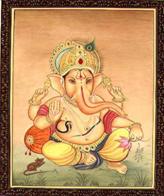

Mushikavaahana
modaka hastha,
Chaamara karna vilambitha sutra,
Vaamana rupa maheshwara putra,
Vighna vinaayaka paada namasthe
Meaning: "O Lord Vinayaka! The remover of all obstacles,
the son of Lord Shiva, with a form which is very short, with mouse as Thy
vehicle, with sweet pudding in hand, with wide ears and long hanging trunk, I
prostrate at Thy lotus-like Feet!"
Salutations
to Lord Ganesha who is Brahman Himself, who is the Supreme Lord, who is the
energy of Lord Shiva, who is the source of all bliss, and who is the bestower
of all virtuous qualities and success in all undertakings. Ganesh Chaturthi is
one of the most popular of Hindu festivals. This is the birthday of Lord
Ganesha. It is the day most sacred to Lord Ganesha. It falls on the 4th day of
the bright fortnight of Bhadrapada (August-September). It is observed
throughout India,
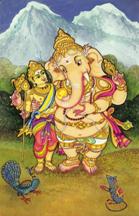
as well as by devoted Hindus in all parts of the world. The son of Shiva and Parvati, Ganesha has an elephantine
countenance with a curved trunk and big ears, and a huge pot-bellied body of a
human being. He is the Lord of success and destroyer of evils and obstacles. He
is also worshipped as the god of education, knowledge, wisdom and wealth. In
fact, Ganesha is one of the five prime Hindu deities (Brahma, Vishnu, Shiva and
Durga being the other four) whose idolatry is glorified as the panchayatana
puja. Lord Ganesha is an embodiment of wisdom and bliss. He is the Lord of
Brahmacharins. He is the presiding Deity of the Muladhara Chakra, the psychic
centre in the body in which the Kundalini Shakti resides. He is the Lord who
removes all obstacles on the path of the spiritual aspirant, and bestows upon
him worldly as well as spiritual success. Hence He is called Vigna Vinayaka. He
is the Lord of power and wisdom. He is the eldest son of Lord Shiva and the
elder brother of Skanda or Kartikeya. He is the energy of Lord Shiva. By
worshipping Lord Ganesha mothers hope to earn for their sons the sterling
virtues of Ganesha. Without the Grace of Sri Ganesha and His help nothing
whatsoever can be achieved. No action can be undertaken without His support,
Grace or blessing. In his first lesson in the alphabet a child is initiated
into the Mantra of Lord Ganesha, Om Sri Ganeshaya Namah
Celebration
of Ganesha Chaturthi!
The
festival of Ganesh Chaturthi is celebrated with great splendor in many parts of
India.
. He is both the beginning of the
religion and the meeting ground for all Hindus. Started by Shivaji, the
great Maratha ruler, to promote culture and nationalism, the festival was
revived by Lokmanya Tilak (a freedom fighter) to spread the message of freedom
struggle and to defy the British who had banned public assemblies. Ganesha
statues installed in street corners and in homes and elaborate arrangements are
made for lighting, decoration, mirrors and the most common of flowers. Pujas
(prayer services) are performed daily. A life-like clay model of Lord Ganesha
is made 2-3 months prior to the day of Ganesh Chaturthi. The size of this idol
may vary from 3/4th of an inch to over 25 feet. The artists who make the idols
of Ganesh compete with each other to make bigger and more magnificent and
elegant idols. These statues are then carried on decorated floats to be
immersed in the sea after one, three, five, seven and ten days. The devotees of
Ganesha are known as 'Ganapatyas', and the festival to celebrate and glorify
him is called Ganesh Chaturthi.
On the day of the festival, it is placed on raised
platforms in homes or in elaborately decorated outdoor tents for people to view
and pay their homage. The priest, usually clad in red silk dhoti and shawl,
then invokes life into the idol amidst the chanting of mantras. This ritual is
the pranapratishhtha. After this the shhodashopachara (16 ways of
paying tribute) follows. Coconut, jaggery, 21 modakas (rice flour
preparation), 21 durva (trefoil) blades and red flowers are offered. The
idol is anointed with red unguent (rakta chandan). Throughout the
ceremony, Vedic hymns from the Rig Veda and Ganapati Atharva Shirsha
Upanishad, and Ganesha stotra from the Narada Purana are
chanted. For 10 days, from Bhadrapad
Shudh Chaturthi to the Ananta
Chaturdashi, Ganesha is worshipped. On the 11th day, the image is taken
through the streets in a procession accompanied with dancing, singing, to be
immersed in a river or the sea symbolizing a ritual see-off of the Lord in his
journey towards his abode in Kailash while taking away with him the misfortunes
of all man. All join in this final procession shouting "Ganapathi Bappa
Morya, Purchya Varshi Laukariya" (O father Ganesha, come again early next
year). After the final offering of coconuts, flowers and camphor is made,
people carry the idol to the river to immerse it. Thousands of processions
converge on the beaches to immerse the holy idols in the sea. This procession
and immersion is accompanied by drum- beats, devotional songs and dancing.
On the Ganesh Chaturthi day, one should meditate on Lord
Ganesha early in the morning, during the Brahmamuhurta (early morning) period.
Offer prayers of Lord Ganesha, offering Him some coconut and sweet pudding.
Prayer with faith and devotion will remove all the obstacles that one
experience on the spiritual path. He can be prayed at home with full devotion.
Pray to Lord Ganesha for inner spiritual strength to attain success in all your
undertakings. Don't forget not to look at the moon on that day; remember that
it behaved unbecomingly towards the Lord. This really means avoid the company
of all those who have no faith in God, and who deride God, your Guru and
religion, from this very day.
May
the blessings of Sri Ganesha be upon you all! May He remove all the obstacles
that stand in your spiritual path! May He bestow on you all material prosperity
as well as liberation!

Source: http://hinduism.about.com
|
|
|
|
|
 |
|
|
|
Submit feedback to newsletter@mahaganapati.org
with
subject line as <Reader Articles>
Disclaimer: Views of readers/column
writers are that of their own and not of the Temple
|
|


