Vageesh Express


Recipe Corner

Vageesh Express
Recipe Corner
Let us be together,
Let us eat together,
Let us be vital together,
Let us be radiating truth, radiating the light of life,
Never shall we denounce anyone, never entertain negativity.
-The Upanishad

Indian cuisine is As Diverse as Its Civilization.
The
finest of India's cuisines is as rich and diverse as its civilization. It is an
art form that has been passed on through generations purely by word of mouth,
from guru (teacher) to vidhyarthi (pupil) or from mother to
daughter. The range assumes astonishing proportions when one takes into account
regional variations. Very often the taste, color, texture and appearance of the
same delicacy changes from state to state.
The
hospitality of the Indians is legendary. In Sanskrit Literature the three
famous words 'Atithi Devo Bhava' or
'the guest is truly your god' are a dictum of hospitality in India. Indians
believe that they are honored if they share their mealtimes with guests. Even
the poorest look forward to guests and are willing to share their meager food
with guest. And of particular importance is the Indian woman's pride that she
will not let a guest go away unfed or unhappy from her home. Indians are known
for their incredible ability to serve food to their guests - invited or
uninvited. Food customarily forms the crowning part of most festivities and
celebrations. Whatever the occasion Indians eat with great gusto and are adept
at finding reasons to feast and make merry. At traditional and festive meals,
the thali (plate) or banana leaf is
decorated with rangoli (a design
drawn with white and colored powders around the edges).
One
can eat a different Indian dish everyday, but still not repeat it for an entire
year! The food of India offers a staggering range of dishes to the gourmet with
an adventurous palate. Essentially spicy, the cuisine is, however, not always
hot. It is the different combination of a handful of spices that produce the
most delectable dishes in the world. In India, preparation of food is an art,
perfected over time and passed through generation by just word of mouth.
It
is interesting to note that Bangladesh cuisine also is somewhat similar to
Indian Cusine. A staple across the country however is rice and various kinds of
lentil, which is locally known as dal. The staples of Bangladeshi cuisine are
rice, atta (whole wheat flour), and at least five dozen varieties of pulses,
the most important of which are chana (bengal gram), toor (pigeon pea or red
gram), urad (black gram), and mung (green gram). Pulses are used almost
exclusively in the form of dal, except chana, which is often cooked whole for
breakfast and is processed into flour (besan). The West and North-west have
high level of Persio-Arabic influence in the cuisine in and here Vegetable
curries heavily occupy the main eating in these areas. Here is a very nice korma dish from this region. Try another
recipe Masala Peanut as a snack to
serve in the party!
Bangladesh
Vegetable Kurma
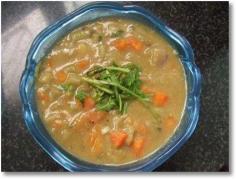
Ingredients:
1-1/2 pound - Mixed vegetables (potato,
cauliflower, yam, carrot)
1 Tsp - Saffron, roasted and powdered
4 Tbsp - Milk
2 Tsp - Garam Masala
2-1/2 oz - Yoghurt
5 oz - Double Cream
2 Tbsp - Ground Almonds
Few Saffron strands
Salt to taste
Butter/Ghee or vegetable to sauté
For
Garnish
Chopped fresh Coriander leaves
Some 20 Almonds whole, roasted
Method:
· Mix together the saffron powder and milk.
· Heat the ghee in a pan and quick-fry the vegetables for a few minutes, then pour in the saffron milk and stir-fry,
· Let the mixture cook until some of the liquid gets absorbed into the vegetables.
· Now add the Garam masala and stir-fry for 2 more minutes.
· Once the vegetables are close to done, add the yoghurt, cream and ground almonds and when it starts to simmer turn the heat down and stir-fry for 10 minutes more.
· To ensure it does not stick, add milk or water as necessary.
· Place saffron strands in a little warm water and extract as much color as you can by gently mashing with a teaspoon.
· Check that the veggies are cooked right through by cutting a large piece across.
· Simmer on if required. Just prior to serving, add the saffron and salt to taste.
· Garnish with the coriander and almonds, and serve.
Masala Peanuts


Ingredients:
1 pound - Shelled peanuts
1:4 ratio - Gram flour and Rice flour
1 tsp each - Amchur, Cumin powder, Red chili powder
A pinch of baking soda.
Salt to taste
Oil for deep fry
Method:
· Heat a cast-iron skillet. Add shelled peanuts. On medium heat, roast the nuts until lightly colored with a distinct aroma.
· Remove immediately, and take them in a wide plate. Wait until they are cool. Rub and remove the skins.
· In a bowl, take gram flour and rice flour in 4:1 quantity. Add amchur, cumin powder, red chilli powder and salt to taste and a pinch of baking soda.
· Whisk and prepare batter in medium thick consistency by adding water as necessary to the flour such that the batter puts a coat on peanuts.
· Make sure that is not too thin it drips or too thick like facemask. Add the peanuts to the batter.
· Heat oil in a heavy pan for deep-frying. When it starts smoking, lower the heat and drop the batter-coated peanuts.
· Fry until golden, drain and place them on a paper-covered plate.
· Once they are cool, store them in a clean container. Stays fresh for two weeks to a month.
Enjoy the recipes! Keep it simple! Keep it
Authentic! Keep it Indian!
Submit feedback to newsletter@mahaganapati.org with subject line as <Recipe> Disclaimer: Views of readers/column writers are that
of their own and not of the Temple